Champlain Fights beside the Algonquin and Wendat
- Written
- events of late July 1609; printed 1613
- Place
- The western shore of Lake Champlain, near Ticonderoga
- Language
- French
- Kind of source
- travel account
- Reading time
- 6 minutes
- Difficulty
- Moderate
- Intensity
- Medium: a battle in which several Iroquois are shot dead, others are killed or captured, and many on both sides are wounded by arrows; told plainly, nothing graphic
Northeast WoodlandsConquest and resistance in the AmericasColonies and settlements
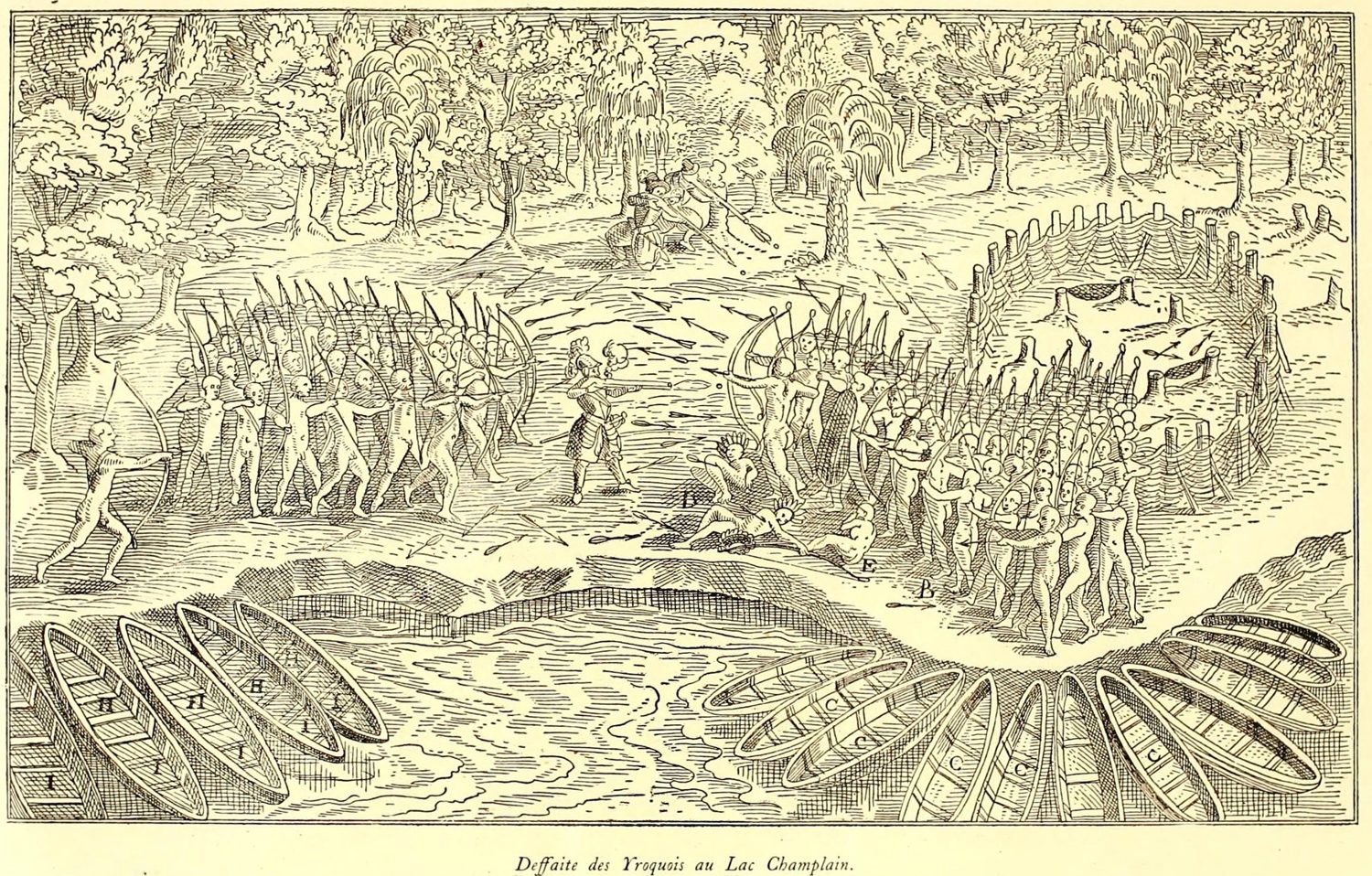
Champlain had loaded four balls into his arquebus. When he fired, two of the three enemy chiefs fell, and a third man was hit and died later. The chiefs had worn armor that stopped arrows, but not lead.
Samuel de Champlain had founded the French post at Quebec the summer before. In 1609 he joined a war party of the Native allies of the French: Montagnais (Innu) from the lower St. Lawrence, Algonquin from the Ottawa River, and Wendat (Huron) from the country near Georgian Bay. They were going south against the Iroquois, most likely the Mohawk, one of the Five Nations. Only two other Frenchmen came with him. In July they met nearly two hundred Iroquois warriors on the lake that Champlain then named after himself.
Champlain was an eyewitness, and he wrote this account for publication in Paris in 1613, four years later. He could not speak his allies’ languages well, and he says himself that they could not understand him. He could see what happened, but he could only guess what the Iroquois thought or meant. He presented the book to the king, and he puts himself at the center of the story.
Notice the rules of the fight: the night of songs and insults, the agreement to wait for daylight, the chiefs marked by their plumes. Notice too the dream his allies asked him about, and what the guns changed. For the Montagnais and Algonquin, the fight was part of an alliance with the French made in 1603. Champlain fought the Mohawk again the next year.
The edited translation, in simplified modern English. Bracketed words were added for clarity; [...] marks a cut. Tap a note number to read the note.
The Night before the Fight
As we came within two or three days’ travel of where their enemies lived, we moved only by night and rested by day. All the same, our allies never stopped performing their usual superstitions1 to learn how their plans would turn out. They often came to ask me whether I had dreamed, and had seen their enemies.2 I told them no, but I kept on giving them courage and good hope. At nightfall we set off and went on until the next day. Then we pulled back into the deep woods and stayed there for the rest of the day. Around ten or eleven o’clock, after a short walk around our camp, I lay down to rest. In my sleep I dreamed that I saw the Iroquois,3 our enemies, drowning in the lake close to a mountain while we watched. I wanted to save them, but our Savage allies4 told me to let them all die, since they were worthless. When I woke up, they asked me, as they always did, if I had had a dream. I told them just what I had seen in it. This made them so confident that they no longer doubted that good fortune was coming to them.
Meeting the Iroquois
When evening came, we set off in our canoes to continue our journey. We were moving very quietly, without any noise. It was the 29th of the month,5 around ten o’clock at night. At the tip of a point that juts into the lake on the western side,6 we met the Iroquois, who were coming to make war. They and we both began to raise great shouts, and everyone readied his weapons. We drew back onto the water. The Iroquois went ashore and lined up all their canoes side by side. They began to cut down trees, with poor axes they sometimes win in war and others of stone, and they built themselves a very good barricade.
Our people, for their part, kept their canoes side by side all night. They tied them to poles so they would not drift apart and could all fight together if they had to. We were a bowshot out on the water from their barricade. When our people were armed and ready, they sent out two canoes from the group to ask the enemy whether they wanted to fight. The enemy answered that they wanted nothing else. But for now, they said, there was little light, and they must wait for day to see each other. As soon as the sun rose, they would give us battle. Our people agreed. While we waited, the whole night passed in dancing and singing on both sides, with no end of insults and other talk. They told us how little courage we had, and how little our weapons could do against theirs, and that when day came we would feel it, to our ruin. Our people had answers ready too. They told them they would see weapons do things they had never seen before. There was plenty of other talk, the kind you hear at the siege of a town.
The Battle
After much singing, dancing, and talk back and forth, day came. My companions and I stayed hidden all the while, so the enemy would not see us. We got our weapons ready as well as we could. We were separated, each in one of the canoes of the Montagnais7 Savages. When we had put on light armor, each of us took an arquebus8 and landed. I watched the enemy leave their barricade. There were nearly two hundred of them, strong and sturdy to look at. They came toward us at a slow pace, with a dignity and confidence that greatly impressed me. Three chiefs led them. Our people advanced in the same order. They told me that the men with three tall plumes were the chiefs. There were only these three, and you could tell them by their feathers, which were much taller than their companions’. They told me to do my best to kill them. I promised to do everything I could. I said I deeply regretted that they could not understand me well enough for me to tell them how to attack their enemies in good order. If they could, we would surely defeat them all. But since nothing could be done about it, I would gladly show them my courage and goodwill when we came to fight.
As soon as we were ashore, our people began to run about two hundred paces toward their enemies. The enemy stood their ground. They had not yet seen my companions, who had slipped into the woods with some of the Savages. Our people began calling for me with loud shouts. They split in two to let me through, and I went to the front. I marched about twenty paces ahead of them, until I was about thirty paces from the enemy. They saw me at once and halted, gazing at me as I gazed at them. As soon as I saw them start to move to shoot at us, I put my arquebus to my cheek and aimed directly at a chief, one of the three. With that shot two of them dropped, and another of their men was wounded and died some time later. I had loaded four balls into my arquebus. When our people saw how well this shot had gone for them, they raised such a shout that you could not have heard thunder. All the while, arrows flew from both sides. The Iroquois were greatly astonished that two men had been killed so quickly, since they wore armor woven of cotton thread and wood, which arrows could not pierce.9 This filled them with fear. As I was reloading, one of my companions shot from inside the woods. This astonished them again so much, with their chiefs dead, that they lost heart and ran. They left the field and their fort behind and fled deep into the woods. I chased them there and brought down still more of them. Our Savages killed several more as well and captured ten or twelve. The rest escaped with the wounded. Fifteen or sixteen of our people were wounded by arrows, but they soon healed.
After the Victory
After we had won, our people spent their time gathering up plenty of the enemy’s Indian corn10 and meal, and their armor, which they had dropped to run faster. After a good feast, with dancing and singing, we set off for home three hours later with the prisoners. The place where this battle was fought lies at forty-three degrees and some minutes of latitude. It was named the lake of Champlain.
The Engraving
Defeat of the Iroquois at Lake Champlain. A: The Iroquois fort. B: The enemy. C: The enemy’s canoes, made of oak bark, each of which can hold 10, 15, or 18 men. D, E: Two chiefs killed, and one wounded by a shot from the sieur de Champlain’s arquebus. F: The sieur de Champlain. G: Two of the sieur de Champlain’s arquebusiers. H: Montagnais, Ochastaiguins,11 and Algonquins. I: The canoes of our allied Savages, made of birch bark. K: The woods.
Notes
- Champlain’s word for his allies’ rites for learning what lay ahead. Earlier in the chapter he describes a diviner who shut himself in a small lodge at each camp and called on a spirit, which Champlain calls the devil. back
- Champlain wrote earlier in the book that his allies believed their dreams were true and foretold what would happen. back
- Here most likely the Mohawk, the easternmost of the Five Nations of the Iroquois (Haudenosaunee), whose country lay in what is now New York State. back
- Champlain’s word is sauvages, used by the French for the Native peoples of America. His allies here were Montagnais (Innu), Algonquin, and Wendat (Huron) warriors. back
- Of July 1609, so the battle was fought on July 30. Champlain’s dates for this journey do not all agree, and the Dictionary of Canadian Biography puts the fight about July 20. back
- A point on the western shore of Lake Champlain. Laverdière and Biggar placed it at Crown Point; Slafter and the Dictionary of Canadian Biography place it at Ticonderoga. back
- The Montagnais, now known as the Innu, of the lower St. Lawrence, allies of the French since 1603. back
- An early gun with a long barrel, fired from the shoulder or cheek. Champlain and the two other Frenchmen with him carried them. back
- Body armor of wooden slats or rods twined together with cord, which the Iroquois, among others, made. Champlain calls the cord cotton thread. back
- Maize, which the Iroquois had brought with them. back
- Champlain’s name for the Wendat (Huron), after one of their chiefs, Ochateguin. back
Or comme nous commençasmes à approcher à quelques deux ou trois iournées de la demeure de leurs ennemis, nous n'allions plus que la nuit, & le iour nous nous reposions, neantmoins ne laissoient de faire tousiours leurs superstitions accoustumées pour sçauoir ce qui leur pourroit succeder de leurs entreprises; & souuent me venoient demander si i'auois songé, & auois veu leurs ennemis : Ie leur disois que non : Neantmoins ne laissois de leur donner du courage, & bonne esperance. La nuit venue nous nous mismes en chemin iusques au lendemain, que nous nous retirasmes dans le fort du bois, pour y passer le reste du iour. Sur les dix ou onze heures, aprés m'estre quelque peu proumené au tour de nostre logement, ie fus me reposer; & en dormant, ie songay que ie voyois les Yroquois nos ennemis, dedans le lac, proche d'vne montaigne, qui se noyoient à nostre veue; & les voulans secourir, nos sauuages alliez me disoient qu'il les falloit tous laisser mourir & qu'ils ne valoient rien. Estant esueillé, ils ne faillirent comme à l'acoustumée de me demander si i'auois songé quelque chose : ie leur dis en effect ce que i'auois veu en songe : Cela leur apporta vne telle creance qu'ils ne douterent plus de ce qui leur deuoit aduenir pour leur bien.
Now as we began to approach within some two or three days' journeys of the dwelling of their enemies, we went only by night, and by day we rested; nevertheless [they] did not cease always to do their accustomed superstitions to know what might come to them of their undertakings; and often [they] came to ask me if I had dreamed, and had seen their enemies: I told them no: Nevertheless [I] did not cease to give them courage and good hope. Night come, we set out on the way until the next day, when we withdrew into the thick of the wood, to pass the rest of the day there. Around ten or eleven o'clock, after having walked a little around our lodging, I went to rest; and while sleeping, I dreamed that I saw the Iroquois our enemies, in the lake, near a mountain, who were drowning in our sight; and [I] wanting to help them, our savage allies told me that we had to let them all die and that they were worth nothing. [I] being awake, they did not fail, as was customary, to ask me if I had dreamed something: I told them in effect what I had seen in a dream: That brought them such a belief that they no longer doubted what was to come to them for their good.
As we came within two or three days’ travel of where their enemies lived, we moved only by night and rested by day. All the same, our allies never stopped performing their usual superstitions to learn how their plans would turn out. They often came to ask me whether I had dreamed, and had seen their enemies. I told them no, but I kept on giving them courage and good hope. At nightfall we set off and went on until the next day. Then we pulled back into the deep woods and stayed there for the rest of the day. Around ten or eleven o’clock, after a short walk around our camp, I lay down to rest. In my sleep I dreamed that I saw the Iroquois, our enemies, drowning in the lake close to a mountain while we watched. I wanted to save them, but our Savage allies told me to let them all die, since they were worthless. When I woke up, they asked me, as they always did, if I had had a dream. I told them just what I had seen in it. This made them so confident that they no longer doubted that good fortune was coming to them.
- Champlain’s word for his allies’ rites for learning what lay ahead. Earlier in the chapter he describes a diviner who shut himself in a small lodge at each camp and called on a spirit, which Champlain calls the devil.
- Champlain wrote earlier in the book that his allies believed their dreams were true and foretold what would happen.
- Here most likely the Mohawk, the easternmost of the Five Nations of the Iroquois (Haudenosaunee), whose country lay in what is now New York State.
- Champlain’s word is sauvages, used by the French for the Native peoples of America. His allies here were Montagnais (Innu), Algonquin, and Wendat (Huron) warriors.
Le soir estant venu, nous nous embarquasmes en nos canots pour continuer nostre chemin, & comme nous allions fort doucement, & sans mener bruit, le 29. du mois, nous fismes rencontre des Yroquois sur les dix heures du soir au bout d'vn cap qui aduance dans le lac du costé de l'occident, lesquels venoient à la guerre. Eux & nous commençasmes à ietter de grands cris, chacun se parant de ses armes. Nous nous retirasmes vers l'eau, & les Yroquois mirent pied à terre, & arrangerent tous leurs canots les vns contre les autres, & commencerent à abbatre du bois auec des meschantes haches qu'ils gaignent quelquesfois à la guerre, & d'autres de pierre, & se barricaderent fort bien.
The evening having come, we embarked in our canoes to continue our way, and as we were going very quietly, and without making noise, on the 29th of the month, we met the Iroquois around ten o'clock at night at the end of a cape which juts into the lake on the western side, who were coming to war. They and we began to raise great cries, each one readying himself with his arms. We withdrew toward the water, and the Iroquois set foot on land, and arranged all their canoes against one another, and began to cut down wood with poor axes which they sometimes win in war, and others of stone, and barricaded themselves very well.
When evening came, we set off in our canoes to continue our journey. We were moving very quietly, without any noise. It was the 29th of the month, around ten o’clock at night. At the tip of a point that juts into the lake on the western side, we met the Iroquois, who were coming to make war. They and we both began to raise great shouts, and everyone readied his weapons. We drew back onto the water. The Iroquois went ashore and lined up all their canoes side by side. They began to cut down trees, with poor axes they sometimes win in war and others of stone, and they built themselves a very good barricade.
- Of July 1609, so the battle was fought on July 30. Champlain’s dates for this journey do not all agree, and the Dictionary of Canadian Biography puts the fight about July 20.
- A point on the western shore of Lake Champlain. Laverdière and Biggar placed it at Crown Point; Slafter and the Dictionary of Canadian Biography place it at Ticonderoga.
Aussi les nostres tindrent toute la nuit leurs canots arrangez les vns contre les autres attachez à des perches pour ne s'esgarer, & combattre tous ensemble s'il en estoit de besoin; & estions à la portée d'vne flesche vers l'eau du costé de leurs barricades. Et comme ils furent armez, & mis en ordre, ils enuoyerent deux canots separez de la trouppe, pour sçauoir de leurs ennemis s'ils vouloient combatre, lesquels respondirent qu'ils ne desiroient autre chose : mais que pour l'heure, il n'y auoit pas beaucoup d'apparence, & qu'il falloit attendre le iour pour se cognoistre : & qu'aussitost que le soleil se leueroit, ils nous liureroient le combat : ce qui fut accordé par les nostres : & en attendant toute la nuit se passa en danses & chansons, tant d'vn costé, que d'autre, auec vne infinité d'iniures, & autres propos, comme, du peu de courage qu'ils auoient, auec le peu d'effet & resistance contre leurs armes, & que le iour venant, ils le sentiroyent à leur ruine. Les nostres aussi ne manquoient de repartie, leur disant qu'ils verroient des effets d'armes que iamais ils n'auoient veu, & tout plain d'autres discours, comme on a accoustumé à vn siege de ville.
Also ours held their canoes all night arranged against one another, tied to poles so as not to stray, and to fight all together if there were need of it; and [we] were within the range of an arrow toward the water from the side of their barricades. And when they were armed and put in order, they sent two canoes separated from the troop to know from their enemies if they wanted to fight, who answered that they desired nothing else: but that for the time being there was not much sign [of it], and that one had to wait for the day to recognize each other: and that as soon as the sun rose, they would give us battle: which was agreed by ours: and while waiting the whole night passed in dances and songs, as much on one side as the other, with an infinity of insults and other remarks, such as the little courage they had, with the little effect and resistance against their arms, and that, the day coming, they would feel it to their ruin. Ours also did not lack retort, telling them that they would see effects of arms such as they had never seen, and plenty of other talk, as is customary at the siege of a town.
Our people, for their part, kept their canoes side by side all night. They tied them to poles so they would not drift apart and could all fight together if they had to. We were a bowshot out on the water from their barricade. When our people were armed and ready, they sent out two canoes from the group to ask the enemy whether they wanted to fight. The enemy answered that they wanted nothing else. But for now, they said, there was little light, and they must wait for day to see each other. As soon as the sun rose, they would give us battle. Our people agreed. While we waited, the whole night passed in dancing and singing on both sides, with no end of insults and other talk. They told us how little courage we had, and how little our weapons could do against theirs, and that when day came we would feel it, to our ruin. Our people had answers ready too. They told them they would see weapons do things they had never seen before. There was plenty of other talk, the kind you hear at the siege of a town.
Aprés auoir bien chanté, dansé & parlementé les vns aux autres, le iour venu, mes compagnons & moy estions tousiours couuerts, de peur que les ennemis ne nous veissent, preparans nos armes le mieux qu'il nous estoit possible, estans toutesfois separez, chacun en vn des canots des sauuages montagnars. Aprés que nous fusmes armez d'armes legeres, nous prismes chacun vne arquebuse & descendismes à terre. Ie vey sortir les ennemis de leur barricade, qui estoient prés de 200. hommes forts & robustes à les voir, qui venoient au petit pas audeuant de nous, auec vne grauité & asseurance qui me contenta fort à la teste desquels y auoit trois chefs.
After having well sung, danced and parleyed with one another, the day come, my companions and I were still covered, for fear that the enemies would see us, preparing our arms the best that was possible to us, being nevertheless separated, each in one of the canoes of the Montagnais savages. After we were armed with light armor, we each took an arquebus and went down on land. I saw the enemies come out of their barricade, who were nearly 200 men, strong and robust to see them, who came at a slow pace toward us, with a gravity and assurance which pleased me much, at the head of whom there were three chiefs.
After much singing, dancing, and talk back and forth, day came. My companions and I stayed hidden all the while, so the enemy would not see us. We got our weapons ready as well as we could. We were separated, each in one of the canoes of the Montagnais Savages. When we had put on light armor, each of us took an arquebus and landed. I watched the enemy leave their barricade. There were nearly two hundred of them, strong and sturdy to look at. They came toward us at a slow pace, with a dignity and confidence that greatly impressed me. Three chiefs led them.
- The Montagnais, now known as the Innu, of the lower St. Lawrence, allies of the French since 1603.
- An early gun with a long barrel, fired from the shoulder or cheek. Champlain and the two other Frenchmen with him carried them.
Les nostres aussi alloient en mesme ordre & me dirent que ceux qui auoient trois grands pannaches estoient les chefs, & qu'il n'y en auoit que ces trois, & qu'on les recognoissoit à ces plumes, qui estoient beaucoup plus grandes que celles de leurs compagnons, & que ie feisse ce que ie pourrois pour les tuer. Ie leur promis de faire ce qui seroit de ma puissance, & que i'estois bien fasché qu'ils ne me pouuoient bien entendre pour leur donner l'ordre & façon d'attaquer leurs ennemis, & que indubitablement nous les desferions tous; mais qu'il n'y auoit remede, que i'estois tres-aise de leur monstrer le courage & bonne volonté qui estoit en moy quand serions au combat.
Ours also went in the same order and told me that those who had three great plumes were the chiefs, and that there were only these three, and that one recognized them by these feathers, which were much bigger than those of their companions, and that I should do what I could to kill them. I promised them to do what would be in my power, and that I was very sorry that they could not understand me well, to give them the order and manner of attacking their enemies, and that undoubtedly we would defeat them all; but that there was no remedy, that I was very glad to show them the courage and good will which was in me when we should be at the fight.
Our people advanced in the same order. They told me that the men with three tall plumes were the chiefs. There were only these three, and you could tell them by their feathers, which were much taller than their companions’. They told me to do my best to kill them. I promised to do everything I could. I said I deeply regretted that they could not understand me well enough for me to tell them how to attack their enemies in good order. If they could, we would surely defeat them all. But since nothing could be done about it, I would gladly show them my courage and goodwill when we came to fight.
Aussitost que fusmes à terre, ils commencerent à courir quelque deux cens pas vers leurs ennemis qui estoient de pied ferme, & n'auoient encores aperçeu mes compagnons, qui s'en allerent dans le bois auec quelques sauuages. Les nostres commencerent à m'appeller à grands cris : & pour me donner passage ils s'ouurirent en deux, & me mis à la teste, marchant quelque 20. pas deuant, iusqu'à ce que ie fusse à quelque 30. pas des ennemis, où aussitost ils m'aperceurent, & firent alte en me contemplant, & moy eux. Comme ie les veis esbranler pour tirer sur nous, ie couchay mon arquebuse en iouë, & visay droit à vn des trois chefs, & de ce coup il en tomba deux par terre, & vn de leurs compagnons qui fut blessé, qui quelque temps aprés en mourut. I'auois mis quatre balles dedans mon arquebuse.
As soon as [we] were on land, they began to run some two hundred paces toward their enemies, who were standing firm and had not yet seen my companions, who went off into the woods with some savages. Ours began to call me with great cries: and to give me passage they opened in two, and [I] put myself at the head, marching some 20 paces in front, until I was some 30 paces from the enemies, where at once they saw me and halted, contemplating me, and I them. As I saw them start to move to shoot at us, I laid my arquebus to my cheek, and aimed straight at one of the three chiefs, and with this shot two of them fell to the ground, and one of their companions who was wounded, who some time after died of it. I had put four balls in my arquebus.
As soon as we were ashore, our people began to run about two hundred paces toward their enemies. The enemy stood their ground. They had not yet seen my companions, who had slipped into the woods with some of the Savages. Our people began calling for me with loud shouts. They split in two to let me through, and I went to the front. I marched about twenty paces ahead of them, until I was about thirty paces from the enemy. They saw me at once and halted, gazing at me as I gazed at them. As soon as I saw them start to move to shoot at us, I put my arquebus to my cheek and aimed directly at a chief, one of the three. With that shot two of them dropped, and another of their men was wounded and died some time later. I had loaded four balls into my arquebus.
Comme les nostres virent ce coup si fauorable pour eux, ils commencerent à ietter de si grands cris qu'on n'eust pas ouy tonner; & cependant les flesches ne manquoyent de costé & d'autre. Les Yroquois furent fort estonnez, que si promptement deux hommes auoyent esté tuez, bien qu'ils fussent armez d'armes tissues de fil de cotton, & de bois à l'espreuue de leurs flesches. Cela leur donna vne grande apprehension. Comme ie rechargeois, l'vn de mes compagnons tira vn coup de dedans le bois, qui les estonna derechef de telle façon, voyant leurs chefs morts, qu'ils perdirent courage, & se mirent en fuite, & abandonnerent le champ, & leur fort, s'enfuyans dedans le profond des bois, où les poursuiuans, i'en fis demeurer encores d'autres. Nos sauuages en tuerent aussi plusieurs, & en prindrent 10. ou 12. prisonniers : Le reste se sauua auec les blessez. Il y en eut des nostres 15. ou 16. de blessez de coups de flesches, qui furent promptement gueris.
When ours saw this shot so favorable for them, they began to raise such great cries that one would not have heard it thunder; and meanwhile the arrows did not fail on one side and the other. The Iroquois were very astonished that so quickly two men had been killed, although they were armed with armor woven of cotton thread and of wood, proof against their arrows. That gave them a great fear. As I was reloading, one of my companions fired a shot from within the woods, which astonished them again in such a way, seeing their chiefs dead, that they lost courage and took to flight, and abandoned the field and their fort, fleeing into the depths of the woods, where, pursuing them, I made still others stay [dead]. Our savages also killed several of them, and took 10 or 12 of them prisoners: The rest escaped with the wounded. There were of ours 15 or 16 wounded by arrow shots, who were promptly healed.
When our people saw how well this shot had gone for them, they raised such a shout that you could not have heard thunder. All the while, arrows flew from both sides. The Iroquois were greatly astonished that two men had been killed so quickly, since they wore armor woven of cotton thread and wood, which arrows could not pierce. This filled them with fear. As I was reloading, one of my companions shot from inside the woods. This astonished them again so much, with their chiefs dead, that they lost heart and ran. They left the field and their fort behind and fled deep into the woods. I chased them there and brought down still more of them. Our Savages killed several more as well and captured ten or twelve. The rest escaped with the wounded. Fifteen or sixteen of our people were wounded by arrows, but they soon healed.
- Body armor of wooden slats or rods twined together with cord, which the Iroquois, among others, made. Champlain calls the cord cotton thread.
Aprés que nous eusmes eu la victoire, ils s'amuserent à prendre force bled d'Inde, & les farines des ennemis, & de leurs armes, qu'ils auoient laissées pour mieux courir. Aprés auoir fait bonne chere, dansé & chanté, trois heures aprés nous en retournasmes auec les prisonniers. Ce lieu où se fit ceste charge est par les 43. degrez & quelques minutes de latitude, & fut nommé le lac de Champlain.
After we had had the victory, they amused themselves taking much Indian corn and the flours of the enemies, and their arms, which they had left in order to run better. After having made good cheer, danced and sung, three hours after we returned with the prisoners. This place where this charge was made is at 43 degrees and some minutes of latitude, and was named the lake of Champlain.
After we had won, our people spent their time gathering up plenty of the enemy’s Indian corn and meal, and their armor, which they had dropped to run faster. After a good feast, with dancing and singing, we set off for home three hours later with the prisoners. The place where this battle was fought lies at forty-three degrees and some minutes of latitude. It was named the lake of Champlain.
- Maize, which the Iroquois had brought with them.
Deffaite des Yroquois au Lac Champlain. A Le fort des Yroquois. B Les ennemis. C Les Canots des ennemis faits d'escorce de chesne, qui peuuent tenir chacun 10. 15. & 18. hommes. D. E. Deux chefs tués, & vn blessé d'vn coup d'arquebuse par le sieur de Champlain. F Le sieur de Champlain. G Deux Arquebusiers du sieur de Champlain. H Montaignets, Ochastaiguins & Algoumequins. I Canots de nos sauuages aliés faits d'escorce de bouleau. K Les bois.
Defeat of the Iroquois at Lake Champlain. A The fort of the Iroquois. B The enemies. C The Canoes of the enemies made of oak bark, which can hold each 10, 15, and 18 men. D. E. Two chiefs killed, and one wounded by a shot of arquebus by the sieur de Champlain. F The sieur de Champlain. G Two Arquebusiers of the sieur de Champlain. H Montagnais, Ochastaiguins and Algonquins. I Canoes of our allied savages made of birch bark. K The woods.
Defeat of the Iroquois at Lake Champlain. A: The Iroquois fort. B: The enemy. C: The enemy’s canoes, made of oak bark, each of which can hold 10, 15, or 18 men. D, E: Two chiefs killed, and one wounded by a shot from the sieur de Champlain’s arquebus. F: The sieur de Champlain. G: Two of the sieur de Champlain’s arquebusiers. H: Montagnais, Ochastaiguins, and Algonquins. I: The canoes of our allied Savages, made of birch bark. K: The woods.
- Champlain’s name for the Wendat (Huron), after one of their chiefs, Ochateguin.
Who and what this source names, in the original. Each name links to every source in the library that mentions it. Not yet checked.
Ideas
- Divination Rites for learning what lay ahead or what the gods or spirits wanted, by signs, dreams, lots or the words of a diviner. Sections 1.
- Dreams that foretell The belief that dreams show what is going to happen. Champlain's allies often asked him whether he had dreamed of their enemies. Sections 1.
- Guns Firearms such as the arquebus and the caliver, which Europeans carried to the Americas, and which were later traded to Native hunters for furs. Sections 4, 6, key.
- Maize (corn) The grain of the Americas, eaten as bread, porridge and drink and planted in hills or holes made with a stick. English writers called it Indian corn. Sections 8.
People
- Samuel de Champlain French explorer who founded Quebec in 1608 and fought beside his Native allies against the Mohawk on Lake Champlain in 1609. He died at Quebec on December 25, 1635. Sections key.
Peoples
- Algonquin A people of the Ottawa River valley, allies of the French, who fought beside Champlain in 1609. Sections key.
- Haudenosaunee (Iroquois) The Five Nations of what is now upstate New York: Mohawk, Oneida, Onondaga, Cayuga and Seneca. The Mohawk, the easternmost, fought Champlain and his allies in 1609. Sections 1, 2, 7, key.
- Innu (Montagnais) A people of the lower St. Lawrence, allies of the French from 1603, who fought beside Champlain in 1609. Sections 4, key.
- Wendat (Huron) A people whose towns lay in the country near Georgian Bay, in present-day Ontario. They were allies and trading partners of the French, and Jesuits lived among them from the 1620s. Sections key.
Places
- The western shore of Lake Champlain, near Ticonderoga The western shore of the lake that Champlain named after himself, where he and his Native allies fought the Mohawk in July 1609. Historians place the fight at Ticonderoga or at Crown Point. Sections 8, key.
Page images of the original object or of the printed edition, from the libraries and archives that hold them. The pages shown are copied here where the holder marks them public domain; titles link to the holder's own viewer. Click a page to see it full size.
Les voyages du sieur de Champlain, Paris 1613
John Carter Brown Library, via Internet Archive. pp. 227–232 (image numbers n268–n273), and the engraving of the fight (n274). Public domain (published 1613).
The first printing. Laverdière’s reprint, which our text follows, keeps its spelling. In this copy the folded engraving is cut off at the left.
Laverdière, ed., Œuvres de Champlain, 2nd ed., vol. 3, Quebec 1870
Internet Archive (University of Pittsburgh Library System). pp. 340–344 (image numbers n269–n273), and the engraving (n276). Public domain (published 1870).
The reprint our text follows, read against these page images.
Other translations of this passage. Links go to copies that are free to read online.
Charles Pomeroy Otis, 1878. English. Public domain.
The whole chapter and the key, pp. 218–224, with Slafter’s note arguing that the fight took place at Ticonderoga.
The Works of Samuel de Champlain, vol. 2, edited by H. P. Biggar (Toronto: Champlain Society, 1925)
John Squair, 1925. English. Public domain.
The whole chapter and the key, pp. 93–101, with the 1613 French text on facing pages.
Difficulty: Moderate, a clear battle story; the notes sort out the peoples and Champlain's names for them.
Fits these units
- First encounters. Whose account of first contact can we trust, and why?
- Violence, disease, and blame. Whom did writers blame for the suffering that followed contact?
Key terms
- allies
- peoples or persons who join together for a shared purpose, especially in war
- superstitions
- Champlain's word for his allies' rites for learning what lay ahead
- barricade
- a wall built quickly to keep out an enemy
- arquebus
- an early gun with a long barrel, fired from the shoulder or cheek
- plume
- a large feather worn on the head, here as a mark of a chief
- latitude
- how far a place lies north or south of the equator, measured in degrees
Questions
- Comprehension
How could Champlain's allies tell which of the Iroquois were the chiefs, and what did they ask him to do?
- Analysis
The Iroquois and Champlain's allies agree to wait for daylight, and both sides spend the night singing, dancing and trading insults. What does this suggest about how the two sides expected a battle to go? How did the French guns change what happened the next morning?
- Analysis (reliability)
Champlain wrote this account four years later, for a book printed in Paris and presented to the king, and he says his allies could not understand him well. Which parts of the story could he see for himself, and which are his guesses about what the Iroquois or his allies thought? Why might he place himself at the center of the story?
- Connection
Read Bloody Point and the Two Captives (Best). Best says the wounded Inuit threw themselves into the sea because they thought the English were cannibals, a reason he could not check by asking them. Champlain says the Iroquois were astonished that two men were killed so quickly, since their armor stopped arrows. Compare how each writer claims to know what the Native fighters thought or felt, and how far you trust each claim.
Activity
Students study the engraving of the fight beside its key and the written account. For each lettered part of the key, they find the matching moment in the text and note where the picture and the words agree, and anything one shows that the other leaves out. Letters A, F, G and K are missing from the picture, and H is printed on the allies' canoes, so students find those parts from the key's descriptions. The class then discusses what the engraving puts at its center and why Champlain might have wanted it drawn that way.
A printable worksheet for this source · More on Hearth Learning
New translation from the French text of Champlain’s Voyages (Paris, 1613), as reprinted by C.-H. Laverdière in Œuvres de Champlain (Quebec, 1870), volume 3, pages 340–344 (pages 227–232 of the 1613 printing), with the key to the engraving that follows. The end of book 2, chapter 9, about a third of the chapter; the earlier part, on the journey up the River of the Iroquois, is left out.
Champlain’s Yroquois is rendered “Iroquois,” and his sauvages “Savages.” His “our people” and “ours” mean his Native allies. His word for their rites, superstitions, is kept. His long sentences joined by colons and “and” are broken up.
- Original
- Text as printed in the named edition or on the object, read from page images. Edition: Samuel de Champlain, Les voyages du sieur de Champlain Xaintongeois (Paris: Jean Berjon, 1613), book 2, chapter 9, pp. 227–232, as reprinted in C.-H. Laverdière, ed., Œuvres de Champlain, 2nd ed., vol. 3 (Quebec: G.-E. Desbarats, 1870), pp. 340–344 (Laverdière’s running heads 192–196), with the engraving that follows. Digital text: Project Gutenberg ebook 17258 (transcription of Laverdière’s edition), extracted by code and read against the page images of the Internet Archive copy (uvresdechamplain03cham); Laverdière’s spelling is kept, with long s printed as s. Laverdière’s notes are not copied. Champlain’s text only.
- Transliterated
- Not needed: the original is in the Latin alphabet
- Close English
- Close translation drafted by Claude (Anthropic), kept as a working draft
- Simplified English
- Drafted by Claude (Anthropic) from the original and checked unit by unit against the original in a separate review, then compared with earlier translations and tested for borrowed wording.
- Editor’s review
- Not yet.
- Specialist review
- Not yet. Readings a specialist should confirm are listed for later review.
- Rights
- Original: public domain. Edition: being checked. Our translations and notes: CC BY-SA 4.0; credit “Hearth Library, hearthinteractive.com” with a link.
Sources for the notes
- Champlain, Samuel de. Les voyages du sieur de Champlain Xaintongeois. Paris: Jean Berjon, 1613. Pp. 227–232 and the engraving. Internet Archive. https://archive.org/details/lesvoyagesdusieu00cham
- Laverdière, C.-H., ed. Œuvres de Champlain. 2nd ed. Vol. 3. Quebec: G.-E. Desbarats, 1870. Editor’s preface, and pages 330–344 with the editor’s notes (on the dates of the journey, the cape, the latitude, and the letters of the engraving). Internet Archive, https://archive.org/details/uvresdechamplain03cham; transcription, Project Gutenberg ebook 17258, https://www.gutenberg.org/ebooks/17258
- Biggar, H. P., ed. The Works of Samuel de Champlain. Vol. 2, translated by John Squair. Toronto: Champlain Society, 1925. Pp. 46–48 (the allies’ belief in dreams), 86–88 (their diviners), and 93–101 (the fight and the key), with the editor’s notes (the month, the cape, the Ochateguins as the Hurons). Internet Archive. https://archive.org/details/worksofsamueldec02chamuoft
- Slafter, Edmund F., ed. Voyages of Samuel de Champlain. Vol. 2, translated by Charles Pomeroy Otis. Boston: Prince Society, 1878. Pp. 218–224, with the editor’s note on the place of the battle. Internet Archive. https://archive.org/details/voyagessamuelde00massgoog
- Hodge, Frederick Webb, ed. Handbook of American Indians North of Mexico. Part 1. Bureau of American Ethnology Bulletin 30. Washington, DC: Government Printing Office, 1907. Articles “Algonkin,” “Armor” (pp. 88–89), “Huron,” and “Mohawk” (on the fight of July 30, 1609). Internet Archive. https://archive.org/details/handbookofameric01hodg
- Litalien, Raymonde. “Champlain, Samuel de.” In Dictionary of Canadian Biography, vol. 1. University of Toronto/Université Laval, 1966; new biography 2023. Sections on the First Nations, the founding of Quebec, the 1613 Voyages, and the expeditions of 1609 and 1610. https://www.biographi.ca/en/bio/champlain_samuel_de_1E.html