Offerings for the Rain God (Dresden Codex, Pages 33 and 35)
Draft: this translation has not yet been checked against the original by a separate review.
- Made
- painted in Yucatán, probably in the century before the Spanish conquest
- Place
- Yucatán
- Language
- Maya (hieroglyphic script)
- Kind of source
- manuscript painting
- Difficulty
- Challenging
- Intensity
- Low
MesoamericaIndigenous American beliefsCalendars and keeping timeFood, farming and hunger
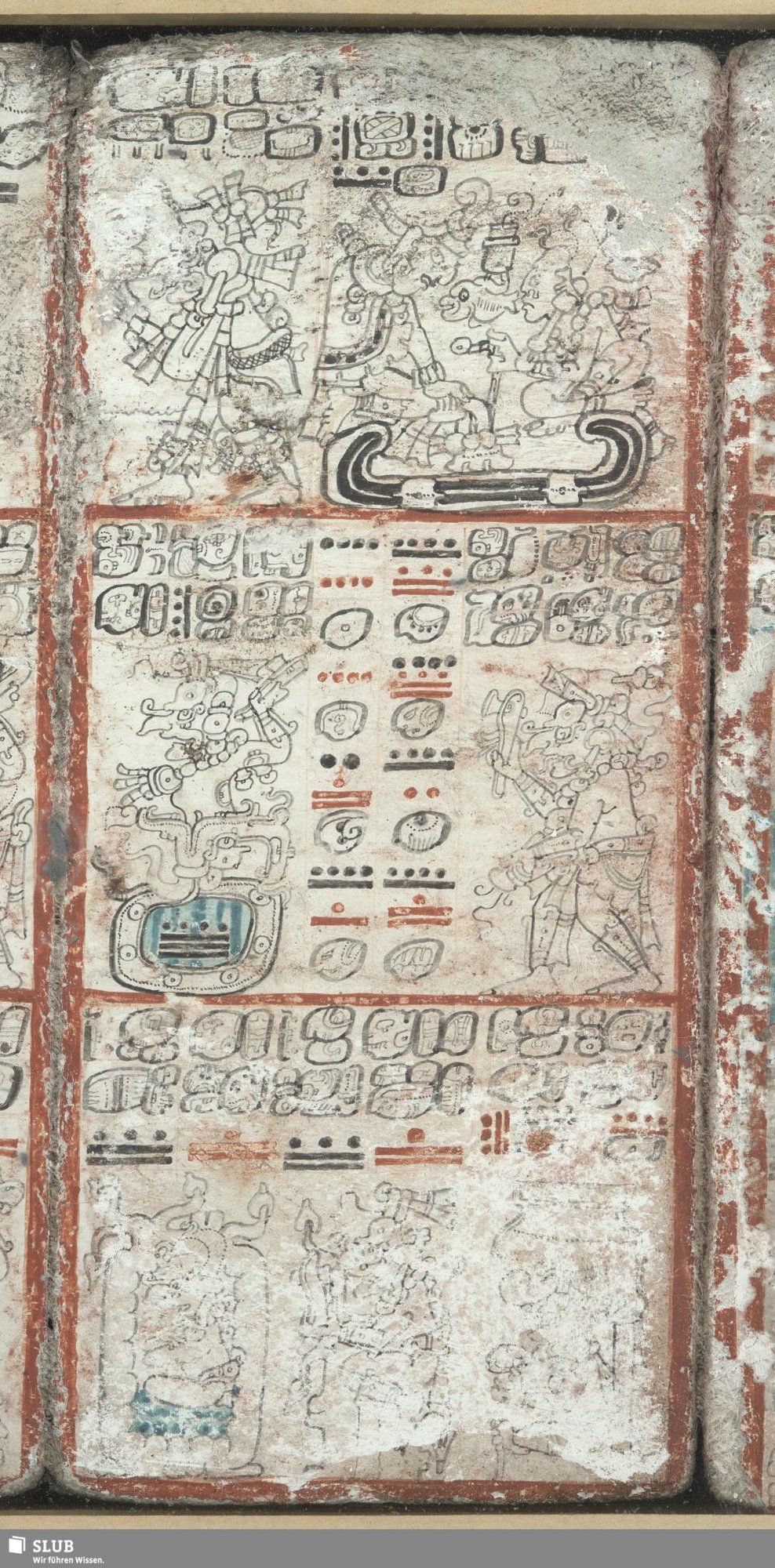
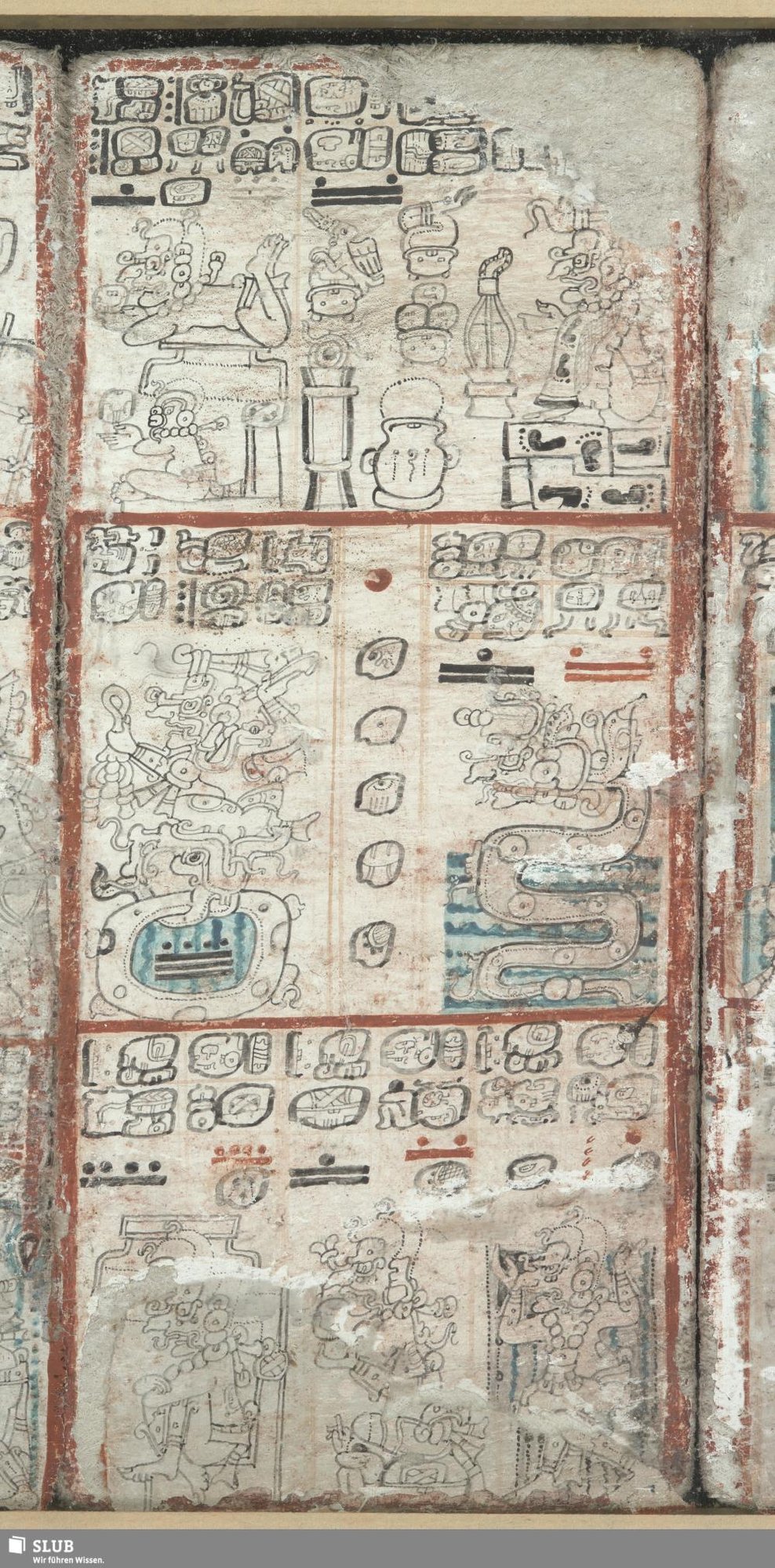
In a pool of blue water lies a coiled serpent, and from its open jaws rises the head of a god. Above, the same god walks with an axe raised. Beside him run two columns of red and black dots and bars: a count of days.
These are two pages of the Dresden Codex, one of the very few Maya books that survived the Spanish conquest. It was painted on a long strip folded like a screen, probably in Yucatán in the century before the Spaniards arrived. In 1739 Johann Christian Götze bought it from a private owner in Vienna, and in 1744 he gave it to the royal library in Dresden, where it still is. It was soaked with water in the bombing of Dresden in the Second World War, which is why some of its figures have faded.
The book is made up of almanacs and astronomical tables. Pages 29 to 45 follow one god through the 260-day count. Scholars of the 1890s called him god B; the library's catalogue calls this section the food offerings for the rain god. On page 33 two people fish beside the water; on page 35 vessels of food, meat and drink are set out as offerings.
We cannot read this script ourselves. Each unit gives what Ernst Förstemann, who had published copies of the codex in 1880 and 1892, could identify in 1906: numbers, day names, the signs for the four directions, and the signs of gods. He could read the numbers and days with confidence, and the rest only in part. He expected his work to be outdated soon. Read the units as a map of the page, not as sentences.
Watch for the red and black numbers, and for the god, who appears again and again as the count moves around the four directions.
The words printed on the image, in simplified modern English.
Page 33, top: the walking god and the fishers
God B1 · the day Imix,2 perhaps marked with the west · day and night3 · a cross-hatched sign with maize4
A sign with darkness in it · [unread] · nine, with the cross sign · nine Imix · [unread] · [unread] · a sign beginning with Yax · [unread]
Page 33, middle: a count of days
The south · the end · the beginning5 · god B, joined to the east · [unread] · perhaps the death god6
Ten Akbal, then nine days · six Eb, nine days · two Imix, nine days · eleven Oc, two days · thirteen Eb, four days · four Cib, nine days · thirteen Chicchan, four days · four Muluc, nineteen days78
The day Manik · god B · Cauac, the sign of rain and water · nine, with a spiral for the serpent · a head with no lower jaw · Caban with a sign like Muluc
Page 35, top: food and drink set out
A year sign · nine Imix · the cross · god D, with darkness · [three signs lost] · nine, with the cross · day and night · one Moan and one Caban · god B · [unread] · Imix, with the west · [worn away]
Page 35, middle: the serpent in the water
The day Manik · god B · Cauac, rain and water · nine, with a spiral for the serpent · a head with no lower jaw · Caban with a sign like Muluc
One, under the days Caban, Muluc, Imix, Ben and Chicchan · eleven days · twelve
Caban with a sign like Muluc · [unread] · the serpent god H9 · day and night
Notes
- Förstemann followed Paul Schellhas in naming the gods of the codices by letters. B is the commonest god in the Dresden Codex; SLUB's catalogue calls him the rain god. back
- Imix, Akbal, Kan, Chicchan, Manik, Muluc, Oc, Eb, Ben, Cib, Caban and Cauac are among the twenty Yucatec Maya day names, as Förstemann spells them. back
- Förstemann reads this pair of signs as day and night, Kin (sun) joined to Akbal (darkness). back
- Kan is a day name; Förstemann took its sign to mean maize bread when it appears among offerings. back
- Förstemann thought this sign meant “end” (Xul) and the head with the dark eye meant “beginning.” back
- Schellhas's god A, whom Förstemann calls the death god. back
- The Maya day count joined thirteen numbers to twenty named days, so the same pairing came round every 260 days. Förstemann used the Nahuatl name tonalamatl for an almanac built on it. back
- Maya numbers are written with dots for ones and bars for fives. In these almanacs the red numbers go with the day names, and the black numbers count the days between them. back
- Förstemann's god H, whom he took to be a serpent god. back
B · west–Imix? · Kin–Akbal · cross-hatched sign with Kan
[god] B · [the day] Imix with the sign of the west [prefixed?] · sun [joined to] darkness · [a] cross-hatched sign with Kan
God B · the day Imix, perhaps marked with the west · day and night · a cross-hatched sign with maize
- Förstemann followed Paul Schellhas in naming the gods of the codices by letters. B is the commonest god in the Dresden Codex; SLUB's catalogue calls him the rain god.
- Imix, Akbal, Kan, Chicchan, Manik, Muluc, Oc, Eb, Ben, Cib, Caban and Cauac are among the twenty Yucatec Maya day names, as Förstemann spells them.
- Förstemann reads this pair of signs as day and night, Kin (sun) joined to Akbal (darkness).
- Kan is a day name; Förstemann took its sign to mean maize bread when it appears among offerings.
Akbal… · [?] · 9 cross b · 9 Imix · [?] · [?] · Yax… · [?]
[a sign] containing Akbal · [unread] · 9 [with] the cross b · 9 Imix · [unread] · [unread] · Yax [prefix only] · [unread]
A sign with darkness in it · [unread] · nine, with the cross sign · nine Imix · [unread] · [unread] · a sign beginning with Yax · [unread]
south · Xul · head with Akbal eye · B–east · [?] · A?
[the] south · Xul, end · [the] head with the Akbal eye, beginning · B [joined to the sign of the] east · [unread] · A [possibly]
The south · the end · the beginning · god B, joined to the east · [unread] · perhaps the death god
- Förstemann thought this sign meant “end” (Xul) and the head with the dark eye meant “beginning.”
- Schellhas's god A, whom Förstemann calls the death god.
X Akbal 9 · VI Eb 9 · II Imix 9 · XI Oc 2 · XIII Eb 4 · IV Cib 9 · XIII Chicchan 4 · IV Muluc 19
10 Akbal, 9 [days] · 6 Eb, 9 · 2 Imix, 9 · 11 Oc, 2 · 13 Eb, 4 · 4 Cib, 9 · 13 Chicchan, 4 · 4 Muluc, 19
Ten Akbal, then nine days · six Eb, nine days · two Imix, nine days · eleven Oc, two days · thirteen Eb, four days · four Cib, nine days · thirteen Chicchan, four days · four Muluc, nineteen days
- The Maya day count joined thirteen numbers to twenty named days, so the same pairing came round every 260 days. Förstemann used the Nahuatl name tonalamatl for an almanac built on it.
- Maya numbers are written with dots for ones and bars for fives. In these almanacs the red numbers go with the day names, and the black numbers count the days between them.
Manik · B · Cauac · 9 spiral · head without lower jaw · Caban–Muluc?
Manik [with a superfix] · B · Cauac [with a prefix] · 9 [prefixed to a] spiral · [a] head without [its] lower jaw · Caban [joined to a sign like] Muluc
The day Manik · god B · Cauac, the sign of rain and water · nine, with a spiral for the serpent · a head with no lower jaw · Caban with a sign like Muluc
year-sign with cross · 9 Imix · cross · D–Akbal · … · 9 cross · Kin–Akbal · 1 Moan–1 Caban · B · [?] · west–Imix · [?]
[a] year sign [with] the cross [above and a leaf-like prefix] · 9 Imix · [the] cross · [the head of god] D with Akbal · [three signs lost] · 9 [with the] cross · sun [joined to] darkness · 1 Moan [and] 1 Caban · B · [unread] · Imix with the sign of the west · [effaced]
A year sign · nine Imix · the cross · god D, with darkness · [three signs lost] · nine, with the cross · day and night · one Moan and one Caban · god B · [unread] · Imix, with the west · [worn away]
Manik · B · Cauac · 9 spiral · head without lower jaw · Caban–Muluc?
Manik [with a superfix] · B · Cauac [with a prefix] · 9 [prefixed to a] spiral · [a] head without [its] lower jaw · Caban [joined to a sign like] Muluc
The day Manik · god B · Cauac, rain and water · nine, with a spiral for the serpent · a head with no lower jaw · Caban with a sign like Muluc
I · Caban · Muluc · Imix · Ben · Chicchan · 11 · XII
1 · Caban · Muluc · Imix · Ben · Chicchan · 11 · 12
One, under the days Caban, Muluc, Imix, Ben and Chicchan · eleven days · twelve
Caban–Muluc? · [?] · H · Kin–Akbal
Caban [joined to] Muluc [possibly] · [unread] · [the serpent god] H · sun [joined to] darkness
Caban with a sign like Muluc · [unread] · the serpent god H · day and night
- Förstemann's god H, whom he took to be a serpent god.
Who and what this source names, in the original. Each name links to every source in the library that mentions it. Not yet checked.
Ideas
- Maize (corn) The grain of the Americas, eaten as bread, porridge and drink and planted in hills or holes made with a stick. English writers called it Indian corn. Sections 33a.1.
- The 260-day count The Maya and Mexican cycle that joined thirteen numbers to twenty named days, so each pairing came round every 260 days. Most almanacs in the Dresden Codex are built on it. Sections 33b.2, 35b.2.
- The four directions East, north, west and south, each with its own sign in Maya writing. Förstemann found them throughout the Dresden almanacs, taken in turn as a count moves on. Sections 33b.1.
People
Page images of the original object or of the printed edition, from the libraries and archives that hold them. The pages shown are copied here where the holder marks them public domain; titles link to the holder's own viewer. Click a page to see it full size.
Codex Dresdensis, Mscr.Dresd.R.310
Sächsische Landesbibliothek – Staats- und Universitätsbibliothek Dresden (SLUB). pages 33 and 35 (files 36 and 38). Public Domain Mark 1.0.
The manuscript itself, photographed after its damage in the Second World War. The record's page numbers follow Förstemann.
Smithsonian Libraries, via the Internet Archive. Public domain (published 1831).
A hand-colored copy made before the war damage; Förstemann still recommended it in 1906. The pages for 33 and 35 have not been located yet.
Other translations of this passage. Links go to copies that are free to read online.
Commentary on the Maya Manuscript in the Royal Public Library of Dresden, pp. 139–142, 152–157
Ernst Förstemann (trans. Selma Wesselhoeft and A. M. Parker), 1906. English. Public domain.
A page-by-page description and partial reading of both pages, not a translation.
This is not a translation in the usual sense. The Maya signs are not in Unicode and cannot be typed, and we cannot read them ourselves. Each `original` is a transcription, in Latin letters, of what Ernst Förstemann identified in each glyph block and number column in his Commentary (1906). “[?]” marks a sign he left unread. Where he was unsure, the transcription ends with a question mark. Roman numerals are red day numbers, Arabic numerals black intervals, as Förstemann writes them.
The English says what each sign is taken to mean. It covers the top and middle thirds of the two pages only, and only the blocks Förstemann discusses.
- Original
- Text as printed in the named edition or on the object, read from page images. Edition: The manuscript: Sächsische Landesbibliothek – Staats- und Universitätsbibliothek Dresden (SLUB), Mscr.Dresd.R.310, pages 33 and 35, digital copy (Public Domain Mark 1.0). Readings: Ernst Förstemann, Commentary on the Maya Manuscript in the Royal Public Library of Dresden, trans. Selma Wesselhoeft and A. M. Parker, Papers of the Peabody Museum 4, no. 2 (Cambridge, MA, 1906), Internet Archive commentary-of-dresden-codex. Förstemann's identifications only; his discussion is paraphrased, not copied.
- Transliterated
- Not yet available: no transliteration policy agreed for this language
- Close English
- Close translation, kept as a working draft
- Simplified English
- Made by Hearth from the original. Not yet checked by a separate review.
- Editor’s review
- Not yet.
- Rights
- Original: public domain. Edition: public domain. Our translations and notes: CC BY-SA 4.0; credit “Hearth Library, hearthinteractive.com” with a link.
Sources for the notes
- Förstemann, Ernst. Commentary on the Maya Manuscript in the Royal Public Library of Dresden. Translated by Selma Wesselhoeft and A. M. Parker. Papers of the Peabody Museum of American Archaeology and Ethnology 4, no. 2. Cambridge, MA, 1906. Preface and pp. 132–133, 139–142, 152–157, 170–171. https://archive.org/details/commentary-of-dresden-codex
- Sächsische Landesbibliothek – Staats- und Universitätsbibliothek Dresden. Codex Dresdensis, Mscr.Dresd.R.310. METS record oai:de:slub-dresden:db:id-280742827 (section titles, page labels, rights). https://digital.slub-dresden.de/id280742827
- Foundation for the Advancement of Mesoamerican Studies (FAMSI). “The Dresden Codex.” https://www.famsi.org/mayawriting/codices/dresden.html
- University of North Carolina Libraries. “Codex Dresdensis,” in the exhibit on Maya codices. https://exhibits.lib.unc.edu/exhibits/show/maya/codices/codices-mayas-codex-dresdensis