“They Gave Him Food”: Two Scenes from the Lienzo de Tlaxcala
Draft: this translation has not yet been checked against the original by a separate review.
- Made
- painted at Tlaxcala between about 1550 and 1561; the events of 1519
- Place
- Tlaxcala
- Language
- Classical Nahuatl
- Kind of source
- manuscript painting
- Difficulty
- Accessible
- Intensity
- Low
MesoamericaConquest and resistance in the AmericasFood, farming and hungerRulers and courts
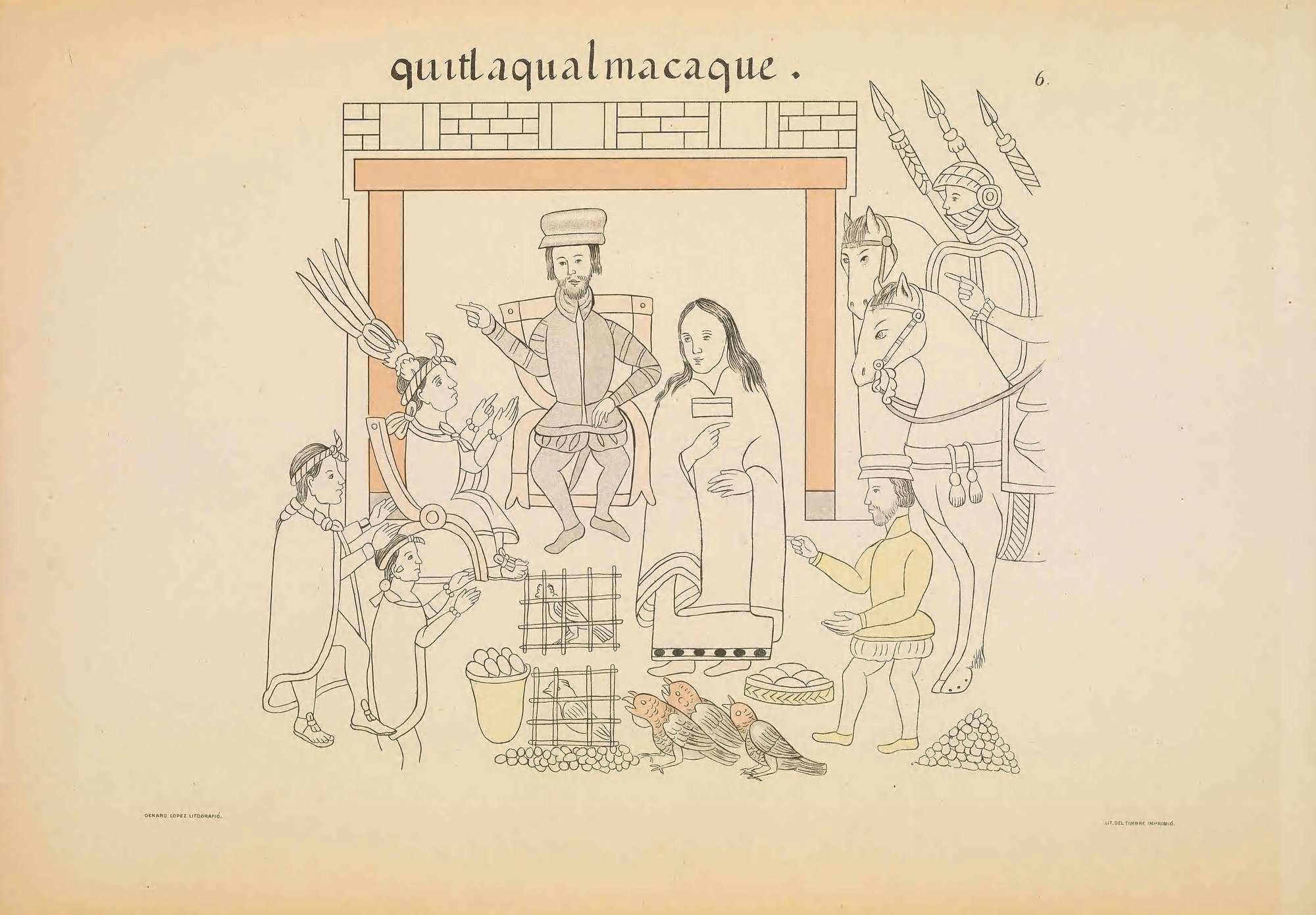
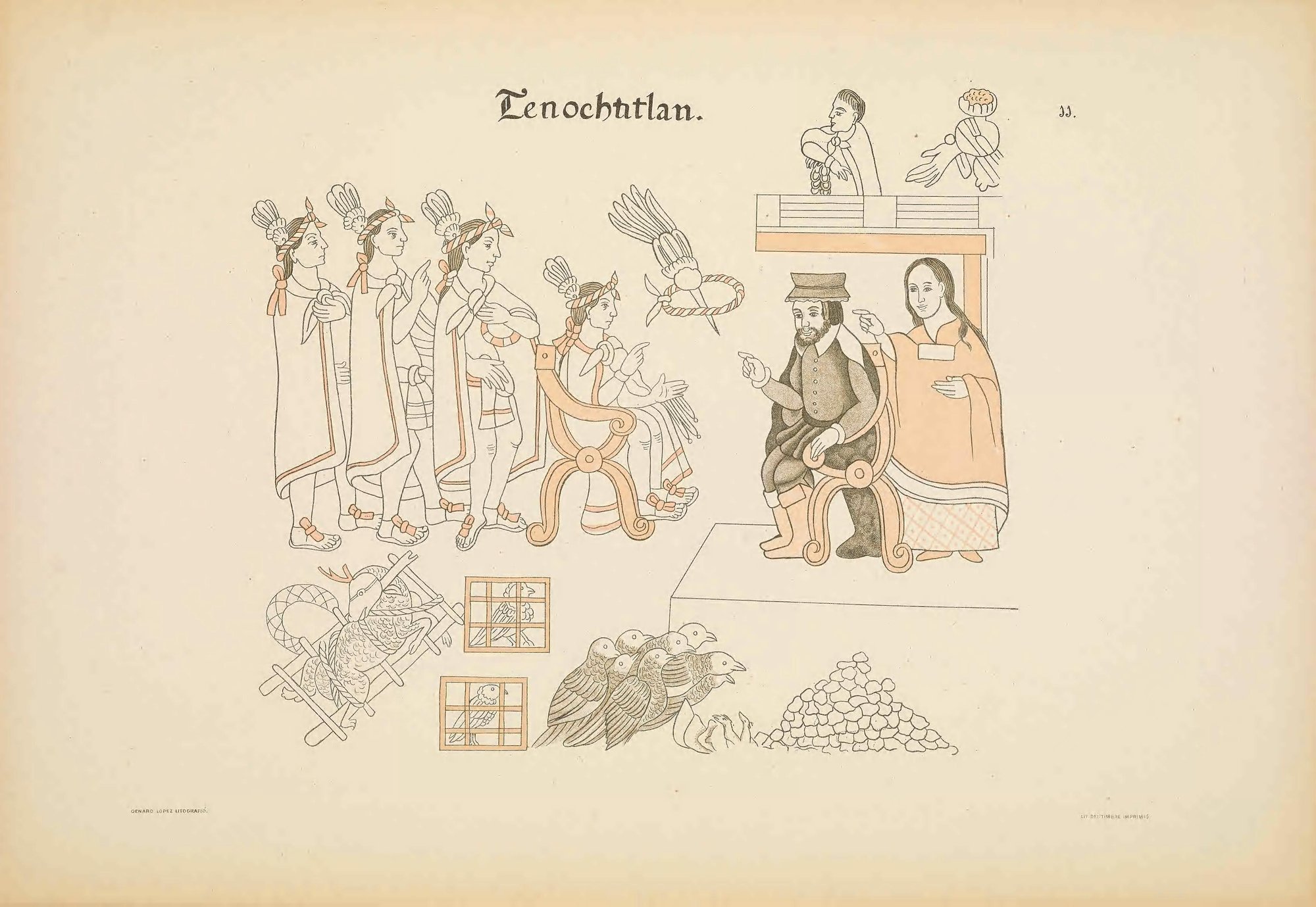
Turkeys stretch their necks toward a heap of maize. Birds sit in cages, a deer lies tied to a carrying frame, and baskets hold tortillas. In both scenes the food is a gift, brought by the lords of a Native city to the Spaniards.
The Lienzo de Tlaxcala was a huge painting on cotton cloth, made at Tlaxcala in the 1550s, about thirty years after the conquest. Tlaxcala, a city-state east of the Mexica, had allied with Hernán Cortés in 1519 and fought beside the Spaniards until Tenochtitlan fell. Its Native rulers had the cloth painted, in about eighty scenes, to show what they had done for the Spanish king and to ask for the rewards they had been promised. Three versions were reportedly made: for Tlaxcala, for the viceroy and for the king. All are now lost. The Tlaxcala copy was taken to Mexico City in the 1860s to be copied and never came back.
These pictures come from a copy made from the original for the historian Alfredo Chavero, who had its scenes redrawn one by one and printed as color lithographs by Genaro López in 1892, for the four-hundredth anniversary of Columbus's voyage. They are a nineteenth-century copy of a sixteenth-century painting.
The painters told the story from Tlaxcala's side, as allies, a generation after the events. In the first scene Cortés sits in the palace of the Tlaxcalan lord Xicotencatl, who speaks with him while his people bring food. In the second, Cortés sits facing Moctezuma at Tenochtitlan. Chavero noticed that the painters gave Moctezuma and his lords Tlaxcalan headdresses rather than Mexica ones.
Watch for the woman beside Cortés in both scenes. She is Malintzin, his interpreter, and she is the one pointing and speaking.
The words printed on the image, in simplified modern English.
Notes
- In Nahuatl, qui- (him) + tlaqualli (food) + maca (give) + -que (they did it). Chavero, who spells it quitlalquamacaque, gives it as “le dieron comida,” “they gave him food.” back
- The Tlaxcalan lords lodged Cortés and his men in their city in 1519 and fed them. According to Chavero, the seated lord facing Cortés is Xicotencatl and the building is his palace. back
- The Mexica capital, on an island in the lake, which Cortés entered in November 1519. Chavero takes this scene to be his first long conversation with Moctezuma in the palace. back
quitlaqualmacaque.
they-gave-him-food.
They gave him food.
- In Nahuatl, qui- (him) + tlaqualli (food) + maca (give) + -que (they did it). Chavero, who spells it quitlalquamacaque, gives it as “le dieron comida,” “they gave him food.”
- The Tlaxcalan lords lodged Cortés and his men in their city in 1519 and fed them. According to Chavero, the seated lord facing Cortés is Xicotencatl and the building is his palace.
Tenochtitlan.
Tenochtitlan.
Tenochtitlan.
- The Mexica capital, on an island in the lake, which Cortés entered in November 1519. Chavero takes this scene to be his first long conversation with Moctezuma in the palace.
Who and what this source names, in the original. Each name links to every source in the library that mentions it. Not yet checked.
Ideas
- Inns, hotels and hospitality Lodging and feeding travelers and guests: a monastery's guest rooms, Roman roadside inns, the Great Khan's post houses, Paris restaurants and the first great city hotels. Sections 6.
Places
- Mexico-Tenochtitlan The Mexica capital, built on an island in a lake in the Valley of Mexico. Cortés entered it in November 1519, was driven out in June 1520, and took it by siege in 1521; Mexico City was built on its site. Sections 11.
Page images of the original object or of the printed edition, from the libraries and archives that hold them. The pages shown are copied here where the holder marks them public domain; titles link to the holder's own viewer. Click a page to see it full size.
Alfredo Chavero, Lienzo de Tlaxcalla (Mexico, 1892): the plates
Smithsonian Libraries, via the Internet Archive. plates 6 and 11. Public domain (published 1892).
The lithographs shown here. The original painting on cloth is lost.
Homenaje á Cristóbal Colón: Antigüedades mexicanas (Mexico, 1892)
Internet Archive. Public domain (published 1892).
The volume with Chavero's explanation of every scene.
Other translations of this passage. Links go to copies that are free to read online.
Alfredo Chavero, 1892. Spanish. Public domain.
Both glosses, with a description of each scene.
New translation from the Nahuatl words written above the two scenes, as they appear on Genaro López's lithographs (1892). Each scene has a single word, both included. The pictures themselves are described in the headnote and footnotes, from Chavero's explanation.
- Original
- Text as printed in the named edition or on the object, read from page images. Edition: Alfredo Chavero, ed., Lienzo de Tlaxcalla (Mexico, 1892), plates 6 and 11, color lithographs by Genaro López, printed by the Litografía del Timbre, from the copy of the lost original that Chavero owned. Smithsonian Libraries copy, Internet Archive lienzodetlaxcal00chav, scans n26 and n36. Plates only; Chavero's text not copied.
- Transliterated
- Not needed: the original is in the Latin alphabet
- Close English
- Close translation, kept as a working draft
- Simplified English
- Made by Hearth from the original. Not yet checked by a separate review.
- Editor’s review
- Not yet.
- Rights
- Original: public domain. Edition: public domain. Our translations and notes: CC BY-SA 4.0; credit “Hearth Library, hearthinteractive.com” with a link.
Sources for the notes
- Chavero, Alfredo, ed. Lienzo de Tlaxcalla. Lithographs by Genaro López. Mexico, 1892. Smithsonian Libraries copy, plates 6 and 11. https://archive.org/details/lienzodetlaxcal00chav
- Chavero, Alfredo. “Explicación del Lienzo de Tlaxcala.” In Homenaje á Cristóbal Colón: Antigüedades mexicanas. Mexico: Junta Colombina, 1892. Introduction (pp. iii–v) and pp. 21, 29–30. https://archive.org/details/homenajecristoba00mexi
- Jaramillo Arango, Mariana, et al. “Un mapa de la conquista de la Nueva España: el ‘Lienzo de Tlaxcala.’” Glocalism: Journal of Culture, Politics and Innovation (2021), no. 2. https://riviste.unimi.it/index.php/glocalism/article/view/20598