Help Us Win!
- Made
- 1917 (sixth war loan, spring 1917)
- Place
- Munich
- Language
- German
- Kind of source
- poster
- Difficulty
- Accessible
- Intensity
- Low: a soldier with grenades, a gas mask, and barbed wire; no wounds or deaths are shown
First World War (1914–1918)Propaganda and persuasionTrade, markets and money
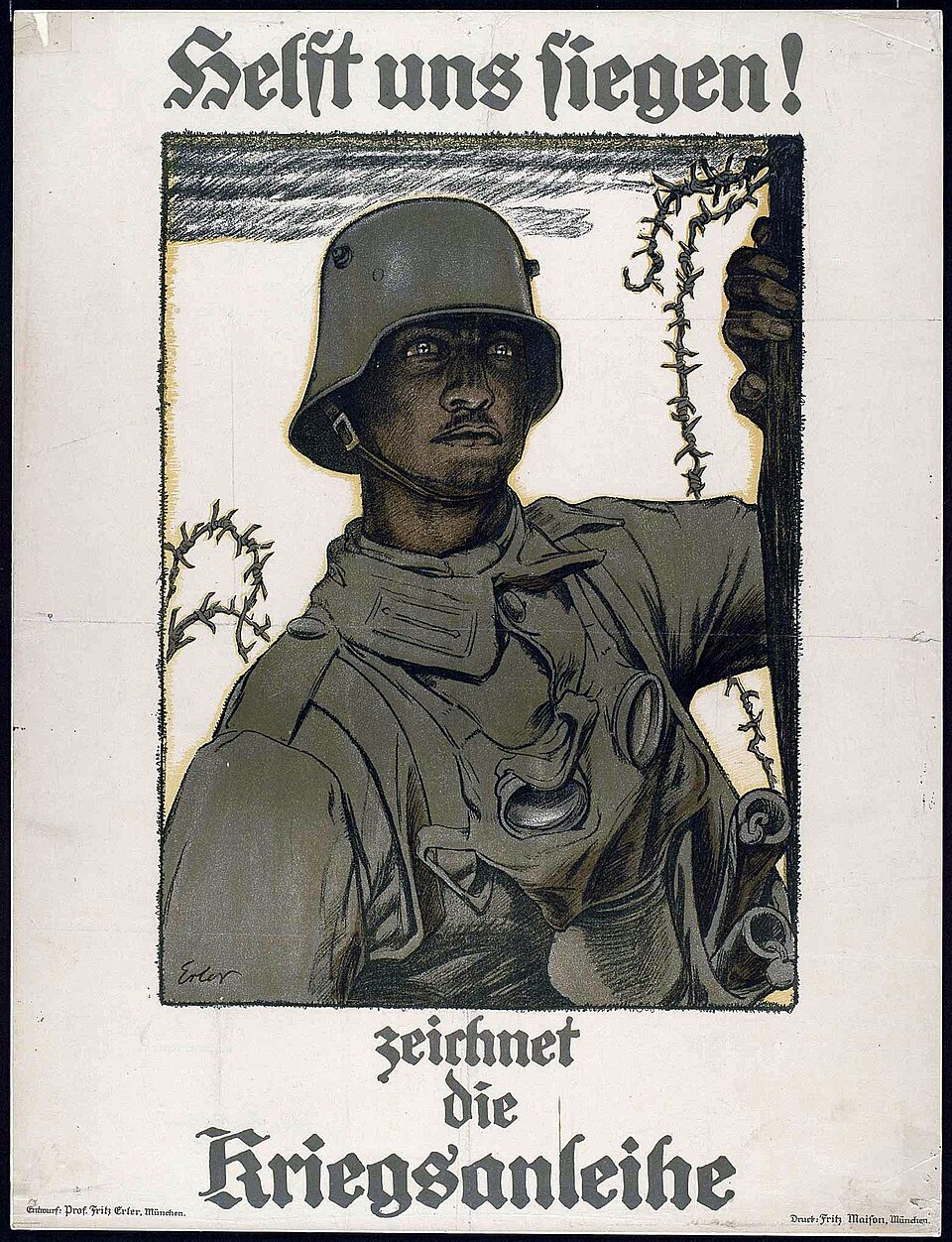
Germany paid for much of the war by borrowing from its own people through a series of war loans. After the fourth loan raised only modest sums, the Imperial Treasury Office began to commission well-known commercial artists for the posters. Fritz Erler, a Munich painter, designed this one for the sixth loan in early 1917.
It shows an ordinary front-line soldier in a steel helmet, with a gas mask and hand grenades, framed by barbed wire. It appeared after the hungry "turnip winter" of 1916–17, when people were reluctant to lend more.
The soldier's face became one of the best-known images of the war. According to the German Tank Museum, a changed version of it was used on the jacket of an English-language edition of Erich Maria Remarque's All Quiet on the Western Front in 1929.
The words printed on the image, in simplified modern English. Point at or tap a phrase to see the original behind it. Phrase links checked in a separate review.
Help us win!
Subscribe to the war loan.1
Designed by Professor Fritz Erler, Munich.
Printed by Fritz Maison, Munich.
Notes
- Kriegsanleihe means war loan. To zeichnen a loan is to sign up for it: people lent the government money in return for interest and the promise of repayment. Germany lost, and its inflation in the early 1920s wiped out most of what they had lent. back
Borrador: esta traducción todavía no se ha revisado por separado. Las palabras entre corchetes se añadieron para que se entienda mejor.
¡Ayúdennos a ganar!
Suscríbanse al empréstito de guerra.1
Diseño del profesor Fritz Erler, Múnich.
Impreso por Fritz Maison, Múnich.
Notas
- Kriegsanleihe significa empréstito de guerra. Zeichnen un empréstito es apuntarse a él: la gente prestaba dinero al gobierno a cambio de intereses y de la promesa de devolverlo. Alemania perdió la guerra, y la inflación de principios de los años veinte acabó con casi todo lo que habían prestado. volver
Helft uns ſiegen!
Help us [to] win!
Help us win!
¡Ayúdennos a ganar!
zeichnet
die
Kriegsanleihe
subscribe the war loan
Subscribe to the war loan.
Suscríbanse al empréstito de guerra.
- Kriegsanleihe means war loan. To zeichnen a loan is to sign up for it: people lent the government money in return for interest and the promise of repayment. Germany lost, and its inflation in the early 1920s wiped out most of what they had lent.
Entwurf: Prof. Fritz Erler, München.
Design: Prof. Fritz Erler, Munich.
Designed by Professor Fritz Erler, Munich.
Diseño del profesor Fritz Erler, Múnich.
Druck: Fritz Maison, München.
Print: Fritz Maison, Munich.
Printed by Fritz Maison, Munich.
Impreso por Fritz Maison, Múnich.
Questions a reader might ask, with short answers and the sections they rest on. Not yet checked.
What happens
What is the poster asking people to do?
To subscribe to the war loan, that is, to lend money to the German government in return for interest and the promise of repayment.
Read section 2
Thinking further
Who is the "us" in "Help us win!"?
The soldier pictured, an ordinary front-line soldier in a steel helmet with a gas mask and grenades. The words seem to come from him, asking people at home to help the men at the front.
Read section 1
Why did Germany need posters like this in 1917?
Germany paid for much of the war by borrowing from its own people, and after the hungry "turnip winter" of 1916–17 they were reluctant to lend more. The government turned to well-known artists to make the appeal stronger.
What happened to the money people lent?
Germany lost the war, and its inflation in the early 1920s wiped out most of what people had lent.
Read section 2
Who and what this source names, in the original. Each name links to every source in the library that mentions it. Not yet checked.
Ideas
- War and service Calls on ordinary people to fight, enlist or give their money so their country can win a war. Sections 1.
- War loans Bonds that governments sold to their own people to pay for a war. Sections 2.
People
- Fritz Erler German painter and designer who worked in Munich, known for murals, stage designs and First World War posters such as Help Us Win!. Sections 3.
Places
Page images of the original object or of the printed edition, from the libraries and archives that hold them. The pages shown are copied here where the holder marks them public domain; titles link to the holder's own viewer. Click a page to see it full size.
Helft uns siegen!, poster, 1917 (Hollerbaum & Schmidt printing)
Australian War Memorial (ARTV07323). Public Domain Mark 1.0 (copyright expired).
Another printing of the same design; ours was printed by Fritz Maison, Munich.
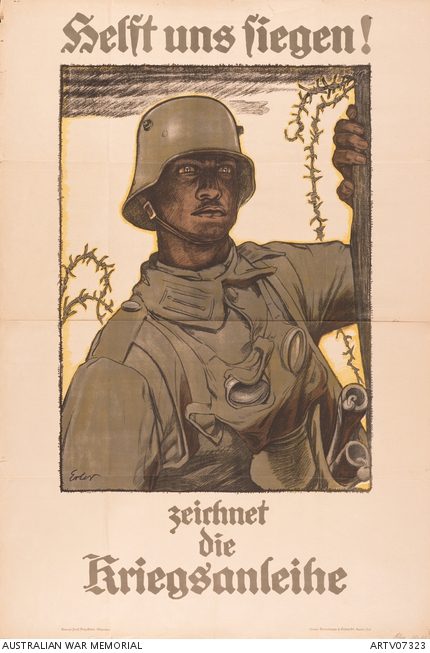
The whole poster Helft uns siegen!, poster, 1917 (Hollerbaum & Schmidt printing)
MAK, Vienna (PI 3624). Image CC BY-NC-ND 4.0 (MAK); the poster itself is in the public domain.
Another copy of the Berlin printing.
Difficulty: Accessible, only a few words on the poster; needs only the note on the war loan.
Fits these units
- How does a poster persuade?. What did wartime posters ask people to do, and how did they make their case?
Key terms
- war loan
- money that citizens lent to their government to pay for the war, in return for interest and the promise of repayment
- subscribe
- to sign up for something; here, to agree to lend money to the government
- interest
- money paid to a person who has lent money, as a reward for lending it
- gas mask
- a mask that protects the wearer from breathing poison gas
- barbed wire
- wire with sharp points along it, strung in front of trenches to slow down attackers
- turnip winter
- the hungry winter of 1916–17 in Germany, when many people had little to eat
- inflation
- a rise in prices that makes money worth less and less
Questions
- Comprehension
What does the poster ask people at home to do, and what does the soldier have with him?
- Analysis
The poster appeared after the turnip winter, when people were slow to lend more. Why might Erler have shown one soldier's face close up instead of a battle scene?
- Analysis (reliability)
The Imperial Treasury Office began hiring well-known artists for the loan posters after an earlier loan raised only modest sums. Whose message is this poster, then? What can it tell us reliably about soldiers at the front, and what can it not?
- Connection
Look at We'll Get Them! by Abel Faivre, a French loan poster from 1916. Its slogan says "We'll get them!"; Erler's says "Help us win!" Who seems to be speaking in each slogan, and to whom? How does that difference change what each poster asks of the viewer?
Activity
In small groups, students find and mark three details in the picture, such as the helmet, the gas mask, the grenades, the barbed wire, or the soldier's face. For each, they write one line on what it tells a person at home about life at the front. Then they read the headnote on the turnip winter and decide which detail would most move a hungry, reluctant lender, and defend their choice to the class.
A printable worksheet for this source · More on Hearth Learning
New translation from the German printed on the poster. The lettering is Fraktur, a German blackletter, which writes s inside a word as ſ (long s).
Nueva traducción al español sencillo. Claude (Anthropic) la redactó a partir del original, con nuestra versión en inglés como guía. Todavía no la ha revisado nadie por separado.
- Original
- Text as printed in the named edition or on the object, read from page images. Edition: Color lithograph, 1917. This printing by Fritz Maison, Munich; others were printed by Hollerbaum & Schmidt, Berlin. The printer is named on the poster itself. Scan: Wikimedia Commons, "Helft uns siegen.jpg".
- Transliterated
- Not needed: the original is in the Latin alphabet
- Close English
- Close translation drafted by Claude (Anthropic), kept as a working draft
- Simplified English
- Drafted by Claude (Anthropic) from the original and checked unit by unit against the original in a separate review.
- Simplified Spanish
- Drafted by Claude (Anthropic). Not yet checked by a separate review.
- Editor’s review
- Not yet.
- Specialist review
- Not yet. Readings a specialist should confirm are listed for later review.
- Rights
- Original: public domain. Edition: public domain. Our translations and notes: CC BY-SA 4.0; credit “Hearth Library, hearthinteractive.com” with a link.
Sources for the notes
- Renz, Irina. "Plakate fürs Vaterland. Die Plakatsammlung der Bibliothek für Zeitgeschichte zum Ersten Weltkrieg." Portal Militärgeschichte, 2014. https://www.portal-militaergeschichte.de/sites/default/files/pdf/renz_plakate.pdf
- Deutsches Panzermuseum. "Object of the Month 03/2017: Propaganda poster 'Help us win'." https://daspanzermuseum.de/en/objekt-of-the-month-03-2017/
- Imperial War Museums. Helft uns siegen! zeichnet die Kriegsanleihe, Art.IWM PST 0444 (another printing, by Hollerbaum & Schmidt, Berlin). https://www.iwm.org.uk/collections/item/object/8675
- Deutsches Historisches Museum. "Der Kohlrübenwinter 1916/17." LeMO. https://www.dhm.de/lemo/kapitel/erster-weltkrieg/alltagsleben/kohlruebenwinter-191617
- Wikimedia Commons. "File:Helft uns siegen.jpg." https://commons.wikimedia.org/wiki/File:Helft_uns_siegen.jpg
