I Want You for U.S. Army
- Made
- 1917 (first drawn for a magazine cover, July 1916)
- Place
- New York
- Language
- English
- Kind of source
- poster
- Difficulty
- Accessible
- Intensity
- Low: nothing violent is shown
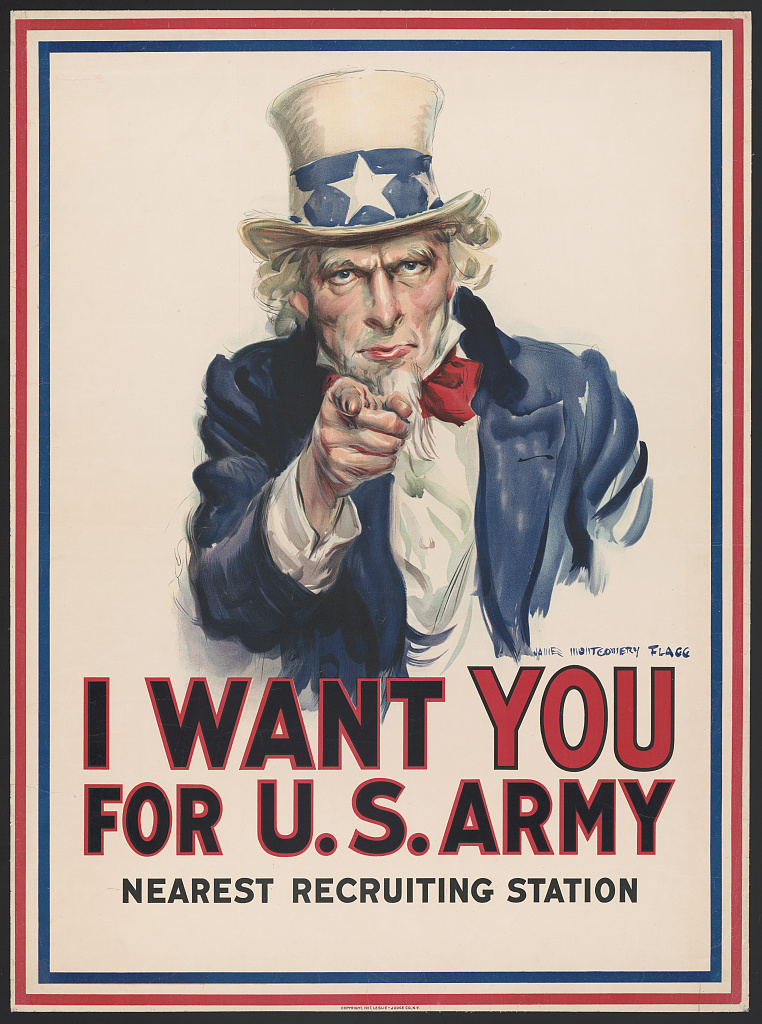
James Montgomery Flagg first drew this Uncle Sam for the cover of Leslie's Weekly on July 6, 1916, under the title "What Are You Doing for Preparedness?" After the United States entered the war in April 1917, the picture became an Army recruiting poster. More than four million copies were printed in 1917 and 1918, and Flagg called it the most famous poster in the world.
Flagg said he used his own face, made older and given a white goatee, for Uncle Sam's. The pointing finger borrowed from a British recruiting image of 1914 showing Lord Kitchener.
Look at how little the poster says, and how it says it: one person, looking straight at you, and the word YOU in a different color. The blank space at the bottom was left for each town to add the address of its own recruiting office.
The words printed on the image, in ordinary sentence case. Point at or tap a phrase to see the words as printed behind it. Phrase links checked in a separate review.
I want you for U.S. Army.
Nearest recruiting station
James Montgomery Flagg
Copyright 1917 Leslie-Judge Co., N.Y.
Borrador: esta traducción todavía no se ha revisado por separado. Las palabras entre corchetes se añadieron para que se entienda mejor.
Te quiero a ti para el Ejército de EE. UU.
Centro de reclutamiento más cercano
James Montgomery Flagg
Copyright 1917 Leslie-Judge Co., Nueva York
I WANT YOU
FOR U.S. ARMY
I want you for U.S. Army.
Te quiero a ti para el Ejército de EE. UU.
NEAREST RECRUITING STATION
Nearest recruiting station
Centro de reclutamiento más cercano
JAMES MONTGOMERY FLAGG
James Montgomery Flagg
James Montgomery Flagg
COPYRIGHT 1917 LESLIE-JUDGE CO. N.Y.
Copyright 1917 Leslie-Judge Co., N.Y.
Copyright 1917 Leslie-Judge Co., Nueva York
Questions a reader might ask, with short answers and the sections they rest on. Not yet checked.
What happens
What does the poster want the viewer to do?
To join the United States Army by going to the nearest recruiting station.
Why is there no address under "Nearest recruiting station"?
The blank space was left so each town could add the address of its own recruiting office.
Read section 2
Thinking further
Why does the poster work with so few words?
One figure looks straight at the viewer and points, and the word YOU stands out in a different color. Each reader feels personally called.
Read section 1
Who and what this source names, in the original. Each name links to every source in the library that mentions it. Not yet checked.
Ideas
- War and service Calls on ordinary people to fight, enlist or give their money so their country can win a war. Sections 1, 2.
People
- James Montgomery Flagg American illustrator whose Uncle Sam, first drawn for a magazine cover in July 1916, became the army's recruiting poster in 1917. Sections 3.
Places
- New York City The largest city in the United States, the center of its publishing trade, and the port from which the steamer Quaker City sailed for Europe and the Holy Land in 1867. Sections 4.
- United States The republic that entered the First World War in April 1917. Its government recruited soldiers and sold war bonds with posters such as Flagg's Uncle Sam. Sections 1.
Dates
Difficulty: Accessible, one short sentence in English; no notes needed.
Fits these units
- How does a poster persuade?. What did wartime posters ask people to do, and how did they make their case?
Key terms
- Uncle Sam
- a figure of an old man in a top hat, dressed in the colors of the flag, used to stand for the United States
- recruiting station
- an office where people sign up to join the armed forces
- recruit
- to find and sign up new people, here new soldiers
- preparedness
- being ready ahead of time; here, getting the country ready in case it went to war
- goatee
- a small beard on the chin
- copyright
- the legal right to control who may copy and sell a picture or text
Questions
- Comprehension
What does the poster ask the viewer to do, and where does it send them?
- Analysis
The poster uses very few words. How do Uncle Sam's finger, his eyes, and the color of the word YOU help make the message feel personal?
- Analysis (reliability)
Flagg first drew this picture for a magazine cover in 1916, before the United States entered the war, and the Army later used it for recruiting. Flagg himself called it the most famous poster in the world. How does this history affect how we read the poster, and how far should we trust what Flagg said about it?
- Connection
Look at We'll Get Them! by Abel Faivre, a French loan poster from 1916. Flagg's Uncle Sam points straight out of the poster, while Faivre's soldier does not look at the viewer. How does each poster place the person looking at it, and how does that fit what each one asks people to do?
Activity
As a class, students list every choice Flagg made, such as one figure, the direct gaze, the pointing finger, the colors, and the blank space for a local address. Each group then sketches a quick version with one choice changed, for example Uncle Sam looking away or YOU printed in black. The class compares the sketches with the poster and decides which change weakens it most, giving reasons.
A printable worksheet for this source · More on Hearth Learning
The poster is in English. The text is shown as printed, in capitals, and in ordinary sentence case.
Nueva traducción al español sencillo. Claude (Anthropic) la redactó a partir del original, con nuestra versión en inglés como guía. Todavía no la ha revisado nadie por separado.
- Original
- Text as printed in the named edition or on the object, read from page images. Edition: Color lithograph, copyright 1917 by the Leslie-Judge Company, New York. Library of Congress, Prints & Photographs Division, POS - US .F63, no. 9.
- Simplified Spanish
- Drafted by Claude (Anthropic). Not yet checked by a separate review.
- Editor’s review
- Not yet.
- Specialist review
- Not yet. Readings a specialist should confirm are listed for later review.
- Rights
- Original: public domain. Edition: public domain. Our translations and notes: CC BY-SA 4.0; credit “Hearth Library, hearthinteractive.com” with a link.
Sources for the notes
- Library of Congress. "I Want You." Echoes of the Great War: American Experiences of World War I exhibition. https://www.loc.gov/exhibitions/world-war-i-american-experiences/about-this-exhibition/over-here/raising-an-army/i-want-you/
- Library of Congress. I want you for U.S. Army: nearest recruiting station / James Montgomery Flagg. https://www.loc.gov/item/96507165/
- Philbrook Museum of Art. "James Montgomery Flagg." https://philbrook.emuseum.com/people/1320/james-montgomery-flagg
- Maine Memory Network. "I Want You for U.S. Army" (item 34081). https://www.mainememory.net/record/34081
- University of Michigan Museum of Art. I Want You for U.S. Army, 1974/2.17. https://umma.umich.edu/objects/i-want-you-for-u-s-army-nearest-recruiting-station-1974-2-17