The Pump in Broad Street, 1854
- Written
- 1855 (events of August–September 1854)
- Place
- London
- Language
- English
- Kind of source
- medical
- Reading time
- 8 minutes
- Difficulty
- Moderate
- Intensity
- Medium: many deaths counted, none described in detail
A widow living in Hampstead, on the edge of London, liked the water from a street pump in Broad Street, Soho, so much that a cart brought her a large bottle of it every day. In early September 1854 she died of cholera, though there was no cholera where she lived.
John Snow was a London physician, known in his day for giving chloroform during operations and childbirth. Since 1849 he had argued that cholera was spread by something passed from the sick and swallowed, most often in drinking water. Most doctors believed instead that cholera came from corrupted air. When cholera struck the streets around Golden Square at the end of August 1854, Snow examined the water, listed the deaths from the government’s death register, and went from house to house asking where each victim had drawn water. He wrote this account within weeks of the outbreak and published it in the enlarged second edition of his book in 1855.
Snow could see no germ in the water, only “small white, flocculent particles,” and he could not say what the “cholera poison” was. His case rests on where people died and what they drank. Much of his evidence came from relatives and neighbors, and many of those who could have answered his questions had died or fled.
Snow was arguing for a theory, and he chose his cases to prove it. He is careful about his own evidence, though. Watch how he deals with the people who did not fit, the ones who drank the water and lived and the ones who died without drinking it. And notice what he says about how far the outbreak had already fallen when the pump handle was taken off.
What we know now
Cholera is caused by a germ carried in water and food fouled by the waste of the sick. Filippo Pacini of Florence described it in 1854, the year of this outbreak, but few noticed; Robert Koch identified it again in 1883 and grew it in pure culture (Lippi and Gotuzzo 2014).
Snow was not the only one investigating. The parish of St. James set up its own Cholera Inquiry Committee, with Snow as a member. Henry Whitehead, curate of St. Luke’s, Berwick Street, began by doubting Snow and ended by confirming his figures. In April 1855 the committee had the well and the drains of 40 Broad Street, the house beside the pump, opened. The cesspool there was decayed and leaking toward the well, and water from washing a sick infant who died on September 2 had been thrown into it just before the outbreak (Cholera Inquiry Committee 1855; Paneth et al. 1998). Snow’s own table counted 616 deaths.
The government’s General Board of Health studied the whole London epidemic at the same time. It tested the Broad Street water at Snow’s request, but it concluded that the air, more than the water, decided where cholera struck (Paneth et al. 1998).
Read alongside
- The Government Explains the Flu, 1918
The U.S. Public Health Service, writing in 1918, could not say which germ caused influenza either, and it too gave advice built on how the disease seemed to spread. Compare what each source counts or observes, and what each asks people to do.
- A London Diary of the Plague Year, 1665
Samuel Pepys followed the weekly bills of mortality during the London plague of 1665 and had reason to doubt them. Snow used the weekly death register too, but he went to the houses himself. Compare what each man did with the official numbers.
The edited translation, in simplified modern English. Bracketed words were added for clarity; [...] marks a cut. Tap a note number to read the note.
The most terrible outbreak of cholera which ever occurred in this kingdom is probably that which took place in Broad Street, Golden Square,1 and the adjoining streets, a few weeks ago. Within two hundred and fifty yards of the spot where Cambridge Street joins Broad Street, there were upwards of five hundred fatal attacks of cholera in ten days. The mortality in this limited area probably equals any that was ever caused in this country, even by the plague;2 and it was much more sudden, as the greater number of cases terminated in a few hours. The mortality would undoubtedly have been much greater had it not been for the flight of the population. Persons in furnished lodgings left first, then other lodgers went away, leaving their furniture to be sent for when they could meet with a place to put it in. Many houses were closed altogether, owing to the death of the proprietors. And, in a great number of instances, the tradesmen who remained had sent away their families, so that in less than six days from the commencement of the outbreak, the most afflicted streets were deserted by more than three-quarters of their inhabitants.
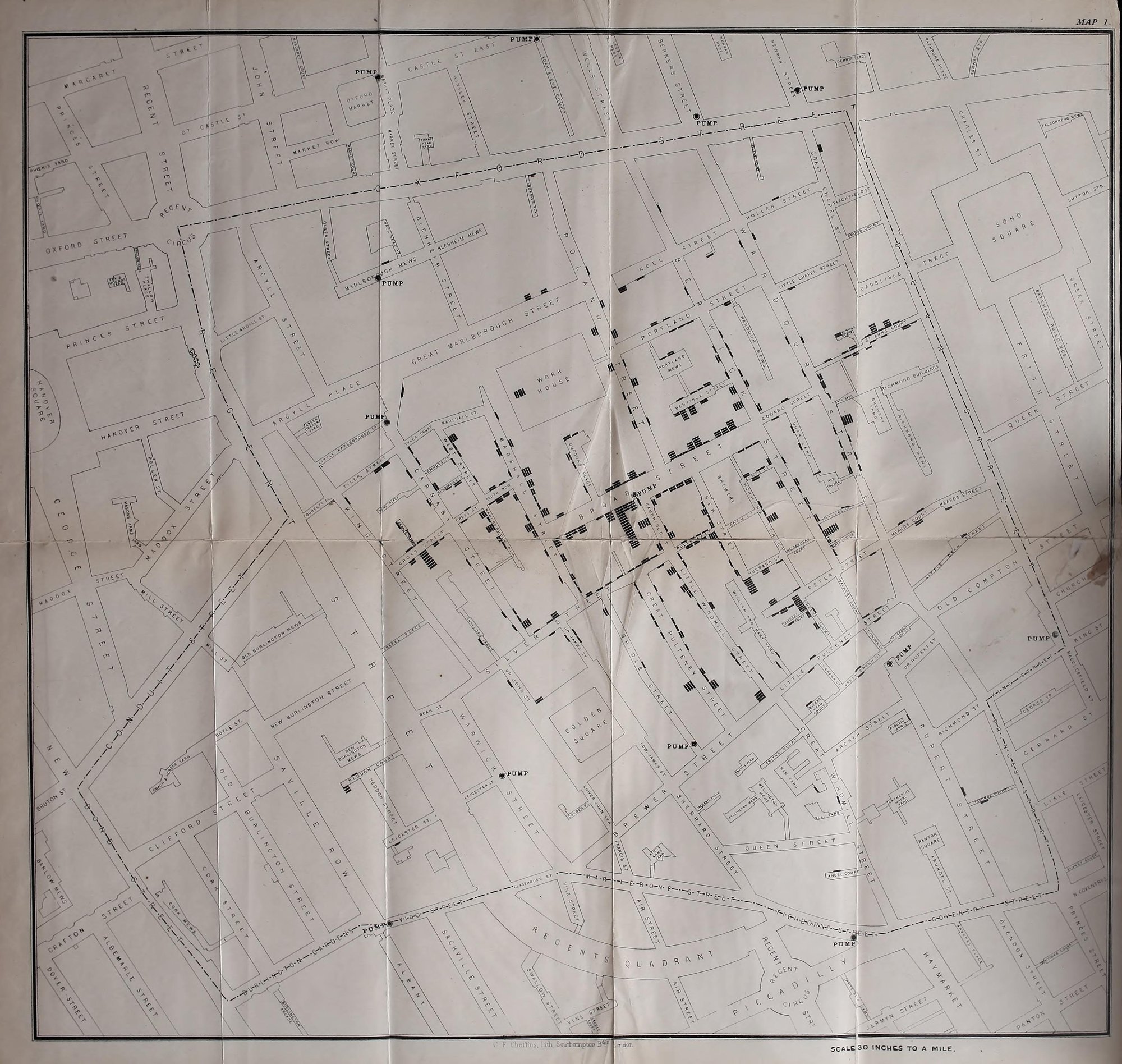
There were a few cases of cholera in the neighborhood of Broad Street, Golden Square, in the latter part of August; and the so-called outbreak, which commenced in the night between the 31st August and the 1st September, was, as in all similar instances, only a violent increase of the malady. As soon as I became acquainted with the situation and extent of this irruption3 of cholera, I suspected some contamination of the water of the much-frequented street-pump in Broad Street, near the end of Cambridge Street. But on examining the water, on the evening of the 3rd September, I found so little impurity in it of an organic nature, that I hesitated to come to a conclusion. Further inquiry, however, showed me that there was no other circumstance or agent common to the circumscribed locality in which this sudden increase of cholera occurred, and not extending beyond it, except the water of the above-mentioned pump. I found, moreover, that the water varied, during the next two days, in the amount of organic impurity, visible to the naked eye, on close inspection, in the form of small white, flocculent particles. And I concluded that, at the commencement of the outbreak, it might possibly have been still more impure. I requested permission, therefore, to take a list, at the General Register Office,4 of the deaths from cholera, registered during the week ending 2nd September, in the subdistricts of Golden Square, Berwick Street, and St. Ann’s, Soho, which was kindly granted. Eighty-nine deaths from cholera were registered, during the week, in the three subdistricts. Of these, only six occurred in the four first days of the week; four occurred on Thursday, the 31st August; and the remaining seventy-nine on Friday and Saturday. I considered, therefore, that the outbreak commenced on the Thursday; and I made inquiry, in detail, respecting the eighty-three deaths registered as having taken place during the last three days of the week.
On proceeding to the spot, I found that nearly all the deaths had taken place within a short distance of the pump. There were only ten deaths in houses situated decidedly nearer to another street pump. In five of these cases the families of the deceased persons informed me that they always sent to the pump in Broad Street, as they preferred the water to that of the pump which was nearer. In three other cases, the deceased were children who went to school near the pump in Broad Street. Two of them were known to drink the water; and the parents of the third think it probable that it did so. The other two deaths, beyond the district which this pump supplies, represent only the amount of mortality from cholera that was occurring before the irruption took place.
With regard to the deaths occurring in the locality belonging to the pump, there were sixty-one instances in which I was informed that the deceased persons used to drink the pump-water from Broad Street, either constantly or occasionally. In six instances I could get no information, owing to the death or departure of everyone connected with the deceased individuals; and in six cases I was informed that the deceased persons did not drink the pump-water before their illness.
The result of the inquiry then was that there had been no particular outbreak or increase of cholera, in this part of London, except among the persons who were in the habit of drinking the water of the above-mentioned pump-well.
I had an interview with the Board of Guardians5 of St. James’s parish, on the evening of Thursday, 7th September, and represented the above circumstances to them. In consequence of what I said, the handle of the pump was removed on the following day.
There are certain circumstances bearing on the subject of this outbreak of cholera which require to be mentioned. The workhouse6 in Poland Street is more than three-fourths surrounded by houses in which deaths from cholera occurred, yet out of five hundred and thirty-five inmates only five died of cholera, the other deaths which took place being those of persons admitted after they were attacked. The workhouse has a pump-well on the premises, in addition to the supply from the Grand Junction Water Works,7 and the inmates never sent to Broad Street for water. If the mortality in the workhouse had been equal to that in the streets immediately surrounding it on three sides, upwards of one hundred persons would have died.
There is a brewery in Broad Street, near to the pump, and on perceiving that no brewer’s men were registered as having died of cholera, I called on Mr. Huggins, the proprietor. He informed me that there were above seventy workmen employed in the brewery, and that none of them had suffered from cholera—at least in a severe form—only two having been indisposed, and that not seriously, at the time the disease prevailed. The men are allowed a certain quantity of malt liquor,8 and Mr. Huggins believes they do not drink water at all; and he is quite certain that the workmen never obtained water from the pump in the street. There is a deep well in the brewery, in addition to the New River water.
Dr. Fraser also first called my attention to the following circumstances, which are perhaps the most conclusive of all in proving the connection between the Broad Street pump and the outbreak of cholera. In the “Weekly Return of Births and Deaths” of September 9th, the following death is recorded as occurring in the Hampstead9 district: “At West End, on 2nd September, the widow of a percussion-cap maker, aged 59 years, diarrhea two hours, cholera epidemica10 sixteen hours.”
I was informed by this lady’s son that she had not been in the neighborhood of Broad Street for many months. A cart went from Broad Street to West End every day, and it was the custom to take out a large bottle of the water from the pump in Broad Street, as she preferred it. The water was taken on Thursday, 31st August, and she drank of it in the evening, and also on Friday. She was seized with cholera on the evening of the latter day, and died on Saturday, as the above quotation from the register shows. A niece, who was on a visit to this lady, also drank of the water. She returned to her residence, in a high and healthy part of Islington, was attacked with cholera, and died also. There was no cholera at the time, either at West End or in the neighborhood where the niece died. Besides these two persons, only one servant partook of the water at Hampstead West End, and she did not suffer, or, at least, not severely. There were many persons who drank the water from Broad Street pump about the time of the outbreak, without being attacked with cholera; but this does not diminish the evidence respecting the influence of the water, for reasons that will be fully stated in another part of this work.
The greatest number of attacks in any one day occurred on the 1st of September, immediately after the outbreak commenced. The following day the attacks fell from one hundred and forty-three to one hundred and sixteen, and the day afterwards to fifty-four. A glance at the above table will show that the fresh attacks continued to become less numerous every day. On September the 8th—the day when the handle of the pump was removed—there were twelve attacks; on the 9th, eleven; on the 10th, five; on the 11th, five; on the 12th, only one; and after this time, there were never more than four attacks on one day. During the decline of the epidemic the deaths were more numerous than the attacks, owing to the decease of many persons who had lingered for several days in consecutive fever.11
There is no doubt that the mortality was much diminished, as I said before, by the flight of the population, which commenced soon after the outbreak. But the attacks had so far diminished before the use of the water was stopped, that it is impossible to decide whether the well still contained the cholera poison12 in an active state, or whether, from some cause, the water had become free from it.
Notes
- Broad Street (now Broadwick Street) and Golden Square are in Soho, in the West End of London. back
- London’s last great outbreak of plague was in 1665. back
- A sudden bursting in. back
- The government office that registered births, marriages and deaths in England and Wales and published weekly lists of deaths in London. back
- The board that ran relief of the poor, including the workhouse, for the parish. back
- A building where poor people who could not support themselves lived and worked, under the Poor Law. back
- One of the private companies that piped water into London houses. The New River Company, named in the next paragraph, was another. back
- Beer. back
- Hampstead and Islington were then on the northern edge of London, a few miles from Soho. back
- Latin, “epidemic cholera,” the term used in the register of deaths. back
- A fever that often followed the first stage of cholera in patients who survived it for a time. back
- Snow’s term for the unknown matter he believed passed from the sick into the water. Filippo Pacini described the cholera germ in 1854, but few noticed; Robert Koch identified it again in 1883. back
The most terrible outbreak of cholera which ever occurred in this kingdom, is probably that which took place in Broad Street, Golden Square, and the adjoining streets, a few weeks ago. Within two hundred and fifty yards of the spot where Cambridge Street joins Broad Street, there were upwards of five hundred fatal attacks of cholera in ten days. The mortality in this limited area probably equals any that was ever caused in this country, even by the plague ; and it was much more sudden, as the greater number of cases terminated in a few hours. The mortality would undoubtedly have been much greater had it not been for the flight of the population. Persons in furnished lodgings left first, then other lodgers went away, leaving their furniture to be sent for when they could meet with a place to put it in. Many houses were closed altogether, owing to the death of the proprietors ; and, in a great number of instances, the tradesmen who remained had sent away their families : so that in less than six days from the commencement of the outbreak, the most afflicted streets were deserted by more than three-quarters of their inhabitants.
The most terrible outbreak of cholera which ever occurred in this kingdom is probably that which took place in Broad Street, Golden Square, and the adjoining streets, a few weeks ago. Within two hundred and fifty yards of the spot where Cambridge Street joins Broad Street, there were upwards of five hundred fatal attacks of cholera in ten days. The mortality in this limited area probably equals any that was ever caused in this country, even by the plague; and it was much more sudden, as the greater number of cases terminated in a few hours. The mortality would undoubtedly have been much greater had it not been for the flight of the population. Persons in furnished lodgings left first, then other lodgers went away, leaving their furniture to be sent for when they could meet with a place to put it in. Many houses were closed altogether, owing to the death of the proprietors. And, in a great number of instances, the tradesmen who remained had sent away their families, so that in less than six days from the commencement of the outbreak, the most afflicted streets were deserted by more than three-quarters of their inhabitants.
- Broad Street (now Broadwick Street) and Golden Square are in Soho, in the West End of London.
- London’s last great outbreak of plague was in 1665.
There were a few cases of cholera in the neighbourhood of Broad Street, Golden Square, in the latter part of August; and the so-called outbreak, which commenced in the night between the 31st August and the 1st September, was, as in all similar instances, only a violent increase of the malady. As soon as I became acquainted with the situation and extent of this irruption of cholera, I suspected some contamination of the water of the much-frequented street-pump in Broad Street, near the end of Cambridge Street ; but on examining the water, on the evening of the 3rd September, I found so little impurity in it of an organic nature, that I hesitated to come to a conclusion. Further inquiry, however, showed me that there was no other circumstance or agent common to the circumscribed locality in which this sudden increase of cholera occurred, and not extending beyond it, except the water of the above mentioned pump. I found, moreover, that the water varied, during the next two days, in the amount of organic impurity, visible to the naked eye, on close inspection, in the form of small white, flocculent particles ; and I concluded that, at the commencement of the outbreak, it might possibly have been still more impure. I requested permission, therefore, to take a list, at the General Register Office, of the deaths from cholera, registered during the week ending 2nd September, in the sub-districts of Golden Square, Berwick Street, and St. Ann’s, Soho, which was kindly granted. Eighty-nine deaths from cholera were registered, during the week, in the three subdistricts. Of these, only six occurred in the four first days of the week ; four occurred on Thursday, the 31st August ; and the remaining seventy-nine on Friday and Saturday. I considered, therefore, that the outbreak commenced on the Thursday ; and I made inquiry, in detail, respecting the eighty-three deaths registered as having taken place during the last three days of the week.
There were a few cases of cholera in the neighborhood of Broad Street, Golden Square, in the latter part of August; and the so-called outbreak, which commenced in the night between the 31st August and the 1st September, was, as in all similar instances, only a violent increase of the malady. As soon as I became acquainted with the situation and extent of this irruption of cholera, I suspected some contamination of the water of the much-frequented street-pump in Broad Street, near the end of Cambridge Street. But on examining the water, on the evening of the 3rd September, I found so little impurity in it of an organic nature, that I hesitated to come to a conclusion. Further inquiry, however, showed me that there was no other circumstance or agent common to the circumscribed locality in which this sudden increase of cholera occurred, and not extending beyond it, except the water of the above-mentioned pump. I found, moreover, that the water varied, during the next two days, in the amount of organic impurity, visible to the naked eye, on close inspection, in the form of small white, flocculent particles. And I concluded that, at the commencement of the outbreak, it might possibly have been still more impure. I requested permission, therefore, to take a list, at the General Register Office, of the deaths from cholera, registered during the week ending 2nd September, in the subdistricts of Golden Square, Berwick Street, and St. Ann’s, Soho, which was kindly granted. Eighty-nine deaths from cholera were registered, during the week, in the three subdistricts. Of these, only six occurred in the four first days of the week; four occurred on Thursday, the 31st August; and the remaining seventy-nine on Friday and Saturday. I considered, therefore, that the outbreak commenced on the Thursday; and I made inquiry, in detail, respecting the eighty-three deaths registered as having taken place during the last three days of the week.
- A sudden bursting in.
- The government office that registered births, marriages and deaths in England and Wales and published weekly lists of deaths in London.
On proceeding to the spot, I found that nearly all the deaths had taken place within a short distance of the pump. There were only ten deaths in houses situated decidedly nearer to another street pump. In five of these cases the families of the deceased persons informed me that they always sent to the pump in Broad Street, as they preferred the water to that of the pump which was nearer. In three other cases, the deceased were children who went to school near the pump in Broad Street. Two of them were known to drink the water ; and the parents of the third think it probable that it did so. The other two deaths, beyond the district which this pump supplies, represent only the amount of mortality from cholera that was occurring before the irruption took place.
On proceeding to the spot, I found that nearly all the deaths had taken place within a short distance of the pump. There were only ten deaths in houses situated decidedly nearer to another street pump. In five of these cases the families of the deceased persons informed me that they always sent to the pump in Broad Street, as they preferred the water to that of the pump which was nearer. In three other cases, the deceased were children who went to school near the pump in Broad Street. Two of them were known to drink the water; and the parents of the third think it probable that it did so. The other two deaths, beyond the district which this pump supplies, represent only the amount of mortality from cholera that was occurring before the irruption took place.
With regard to the deaths occurring in the locality belonging to the pump, there were sixty-one instances in which I was informed that the deceased persons used to drink the pump-water from Broad Street, either constantly or occasionally. In six instances I could get no information, owing to the death or departure of every one connected with the deceased individuals ; and in six cases I was informed that the deceased persons did not drink the pump-water before their illness.
With regard to the deaths occurring in the locality belonging to the pump, there were sixty-one instances in which I was informed that the deceased persons used to drink the pump-water from Broad Street, either constantly or occasionally. In six instances I could get no information, owing to the death or departure of everyone connected with the deceased individuals; and in six cases I was informed that the deceased persons did not drink the pump-water before their illness.
The result of the inquiry then was, that there had been no particular outbreak or increase of cholera, in this part of London, except among the persons who were in the habit of drinking the water of the above-mentioned pump-well.
The result of the inquiry then was that there had been no particular outbreak or increase of cholera, in this part of London, except among the persons who were in the habit of drinking the water of the above-mentioned pump-well.
I had an interview with the Board of Guardians of St. James’s parish, on the evening of Thursday, 7th September, and represented the above circumstances to them. In consequence of what I said, the handle of the pump was removed on the following day.
I had an interview with the Board of Guardians of St. James’s parish, on the evening of Thursday, 7th September, and represented the above circumstances to them. In consequence of what I said, the handle of the pump was removed on the following day.
- The board that ran relief of the poor, including the workhouse, for the parish.
Left out of this excerpt.
Left out of this excerpt.
There are certain circumstances bearing on the subject of this outbreak of cholera which require to be mentioned. The Workhouse in Poland Street is more than three-fourths surrounded by houses in which deaths from cholera occurred, yet out of five hundred and thirty-five inmates only five died of cholera, the other deaths which took place being those of persons admitted after they were attacked. The workhouse has a pump-well on the premises, in addition to the supply from the Grand Junction Water Works, and the inmates never sent to Broad Street for water. If the mortality in the workhouse had been equal to that in the streets immediately surrounding it on three sides, upwards of one hundred persons would have died.
There are certain circumstances bearing on the subject of this outbreak of cholera which require to be mentioned. The workhouse in Poland Street is more than three-fourths surrounded by houses in which deaths from cholera occurred, yet out of five hundred and thirty-five inmates only five died of cholera, the other deaths which took place being those of persons admitted after they were attacked. The workhouse has a pump-well on the premises, in addition to the supply from the Grand Junction Water Works, and the inmates never sent to Broad Street for water. If the mortality in the workhouse had been equal to that in the streets immediately surrounding it on three sides, upwards of one hundred persons would have died.
- A building where poor people who could not support themselves lived and worked, under the Poor Law.
- One of the private companies that piped water into London houses. The New River Company, named in the next paragraph, was another.
There is a Brewery in Broad Street, near to the pump, and on perceiving that no brewer’s men were registered as having died of cholera, I called on Mr. Huggins, the proprietor. He informed me that there were above seventy workmen employed in the brewery, and that none of them had suffered from cholera, — at least in a severe form, — only two having been indisposed, and that not seriously, at the time the disease prevailed. The men are allowed a certain quantity of malt liquor, and Mr. Huggins believes they do not drink water at all ; and he is quite certain that the workmen never obtained water from the pump in the street. There is a deep well in the brewery, in addition to the New River water.
There is a brewery in Broad Street, near to the pump, and on perceiving that no brewer’s men were registered as having died of cholera, I called on Mr. Huggins, the proprietor. He informed me that there were above seventy workmen employed in the brewery, and that none of them had suffered from cholera—at least in a severe form—only two having been indisposed, and that not seriously, at the time the disease prevailed. The men are allowed a certain quantity of malt liquor, and Mr. Huggins believes they do not drink water at all; and he is quite certain that the workmen never obtained water from the pump in the street. There is a deep well in the brewery, in addition to the New River water.
- Beer.
Left out of this excerpt.
Left out of this excerpt.
Dr. Fraser also first called my attention to the following circumstances, which are perhaps the most conclusive of all in proving the connexion between the Broad Street pump and the outbreak of cholera. In the “Weekly Return of Births and Deaths” of September 9th, the following death is recorded as occurring in the Hampstead district: “At West End, on 2nd September, the widow of a percussion-cap maker, aged 59 years, diarrhoea two hours, cholera epidemica sixteen hours.”
Dr. Fraser also first called my attention to the following circumstances, which are perhaps the most conclusive of all in proving the connection between the Broad Street pump and the outbreak of cholera. In the “Weekly Return of Births and Deaths” of September 9th, the following death is recorded as occurring in the Hampstead district: “At West End, on 2nd September, the widow of a percussion-cap maker, aged 59 years, diarrhea two hours, cholera epidemica sixteen hours.”
- Hampstead and Islington were then on the northern edge of London, a few miles from Soho.
- Latin, “epidemic cholera,” the term used in the register of deaths.
I was informed by this lady’s son that she had not been in the neighbourhood of Broad Street for many months. A cart went from Broad Street to West End every day, and it was the custom to take out a large bottle of the water from the pump in Broad Street, as she preferred it. The water was taken on Thursday, 31st August, and she drank of it in the evening, and also on Friday. She was seized with cholera on the evening of the latter day, and died on Saturday, as the above quotation from the register shows. A niece, who was on a visit to this lady, also drank of the water ; she returned to her residence, in a high and healthy part of Islington, was attacked with cholera, and died also. There was no cholera at the time, either at West End or in the neighbourhood where the niece died. Besides these two persons, only one servant partook of the water at Hampstead West End, and she did not suffer, or, at least, not severely. There were many persons who drank the water from Broad Street pump about the time of the outbreak, without being attacked with cholera ; but this does not diminish the evidence respecting the influence of the water, for reasons that will be fully stated in another part of this work.
I was informed by this lady’s son that she had not been in the neighborhood of Broad Street for many months. A cart went from Broad Street to West End every day, and it was the custom to take out a large bottle of the water from the pump in Broad Street, as she preferred it. The water was taken on Thursday, 31st August, and she drank of it in the evening, and also on Friday. She was seized with cholera on the evening of the latter day, and died on Saturday, as the above quotation from the register shows. A niece, who was on a visit to this lady, also drank of the water. She returned to her residence, in a high and healthy part of Islington, was attacked with cholera, and died also. There was no cholera at the time, either at West End or in the neighborhood where the niece died. Besides these two persons, only one servant partook of the water at Hampstead West End, and she did not suffer, or, at least, not severely. There were many persons who drank the water from Broad Street pump about the time of the outbreak, without being attacked with cholera; but this does not diminish the evidence respecting the influence of the water, for reasons that will be fully stated in another part of this work.
Left out of this excerpt.
The greatest number of attacks in any one day occurred on the 1st of September, immediately after the outbreak commenced. The following day the attacks fell from one hundred and forty-three to one hundred and sixteen, and the day afterwards to fifty-four. A glance at the above table will show that the fresh attacks continued to become less numerous every day. On September the 8th — the day when the handle of the pump was removed — there were twelve attacks ; on the 9th, eleven ; on the 10th, five ; on the 11th, five ; on the 12th, only one ; and after this time, there were never more than four attacks on one day. During the decline of the epidemic the deaths were more numerous than the attacks, owing to the decease of many persons who had lingered for several days in consecutive fever.
The greatest number of attacks in any one day occurred on the 1st of September, immediately after the outbreak commenced. The following day the attacks fell from one hundred and forty-three to one hundred and sixteen, and the day afterwards to fifty-four. A glance at the above table will show that the fresh attacks continued to become less numerous every day. On September the 8th—the day when the handle of the pump was removed—there were twelve attacks; on the 9th, eleven; on the 10th, five; on the 11th, five; on the 12th, only one; and after this time, there were never more than four attacks on one day. During the decline of the epidemic the deaths were more numerous than the attacks, owing to the decease of many persons who had lingered for several days in consecutive fever.
- A fever that often followed the first stage of cholera in patients who survived it for a time.
There is no doubt that the mortality was much diminished, as I said before, by the flight of the population, which commenced soon after the outbreak ; but the attacks had so far diminished before the use of the water was stopped, that it is impossible to decide whether the well still contained the cholera poison in an active state, or whether, from some cause, the water had become free from it.
There is no doubt that the mortality was much diminished, as I said before, by the flight of the population, which commenced soon after the outbreak. But the attacks had so far diminished before the use of the water was stopped, that it is impossible to decide whether the well still contained the cholera poison in an active state, or whether, from some cause, the water had become free from it.
- Snow’s term for the unknown matter he believed passed from the sick into the water. Filippo Pacini described the cholera germ in 1854, but few noticed; Robert Koch identified it again in 1883.
Questions a reader might ask, with short answers and the sections they rest on. Checked in a separate review.
What happens
How many people died, and how fast?
More than five hundred people died of cholera within 250 yards of one spot in ten days, and most cases ended in a few hours. Within six days the worst streets had lost more than three-quarters of their people, who had left or died.
Read section 1
Why did Snow suspect the Broad Street pump?
Nearly all the deaths were close to it, and he found nothing else shared by the area of the outbreak and not beyond it. At first he found too little impurity in the water to be sure, but over the next two days he saw small white particles in it.
How did Snow explain the deaths in houses nearer to other pumps?
Of ten such deaths, five were in families who preferred the Broad Street water and sent for it, and three were children who went to school near the pump. The last two matched the few cases there had been before the outbreak.
Read section 3
What happened after Snow spoke to the Board of Guardians?
He met them on the evening of Thursday, September 7, 1854, and the handle of the pump was removed the next day.
Read section 6
Thinking further
Why are the workhouse and the brewery important to Snow's case?
Both were close to the pump, yet only five of 535 workhouse inmates died and none of the seventy brewery workers suffered badly. The workhouse had its own well, and the brewery men drank malt liquor and had a deep well; neither sent to Broad Street for water.
Why does Snow call the widow in Hampstead perhaps the most conclusive case?
She had not been near Broad Street for months, and there was no cholera where she lived. She drank water carried to her from the pump, fell ill and died, and so did a niece who drank it and went home to Islington.
Does Snow claim that removing the pump handle ended the outbreak?
No. He says the attacks had already fallen a great deal before the water was stopped, so it is impossible to decide whether the well still held the cholera poison. He also says the flight of the people lowered the number of deaths.
Who and what this source names, in the original. Each name links to every source in the library that mentions it. Not yet checked.
Ideas
- Bills of mortality Printed weekly or yearly counts of burials with the causes of death, compiled from parish clerks' reports, as in London in 1665 and Philadelphia in 1793, and from 1837 the Registrar General's weekly returns. Sections 2.
- Cholera A disease that spread up the Volga into central Russia in 1830, when Pushkin and many Russians called it “the plague,” and struck London in 1854, where John Snow traced it to a water pump. Sections 1, 13.
- Fear and flight How people met an epidemic: with fear and despair, by shunning the sick, or by fleeing the town. Sections 1.
- Germs Microscopic organisms that cause disease. They were widely accepted as the cause of diseases such as cholera only after Robert Koch's work of the 1880s, and in 1918 many doctors wrongly blamed influenza on Pfeiffer's bacillus. Sections 17.
- Quarantine and public health measures Keeping the sick, travelers or goods out of a city or away from the healthy, and cleaning the streets, by order of officials: from Florence in 1348 to the cholera posts of 1830 and the plague searches of 1897. Sections 6.
- Relief for the sick and poor Help given by rulers, churches or neighbors: food, medicine, tax relief, care. Sections 9.
- Water and disease Drinking water as a carrier of disease: John Snow traced the cholera of 1854 to the Broad Street pump, and typhoid was known by 1909 to spread through tainted food or water. Sections 2.
Organizations
- The Board of Guardians of St. James's parish The elected board of the parish of St. James, Westminster, where Broad Street lay, which had run the parish's poor relief and its workhouse under a local act since 1762. Snow put his evidence to it on September 7, 1854, and the pump handle was removed the next day. Sections 6.
- The General Register Office The office set up under an act of 1836 to register the births, marriages and deaths of England and Wales, from 1837, and to keep figures on them. Snow took from it the list of cholera deaths around Broad Street in 1854. Sections 2.
Places
- Broad Street, Soho The street in Soho whose public pump John Snow traced as the source of the cholera outbreak of 1854. The pump handle was removed on September 8. Sections 1.
- Hampstead Then a village on the northern edge of London, where a widow died of cholera in 1854 after drinking water carried from the Broad Street pump. Sections 13.
- Islington Then a district on the northern edge of London, where the widow's niece died of cholera after drinking the Broad Street water. Sections 14.
- London England's largest city and the seat of the royal government. Pepys kept his diary there through the plague of 1665, and John Snow traced the cholera of 1854 to a pump in Broad Street. Sections 5.
Page images of the original object or of the printed edition, from the libraries and archives that hold them. The pages shown are copied here where the holder marks them public domain; titles link to the holder's own viewer. Click a page to see it full size.
Snow, On the Mode of Communication of Cholera, 2nd ed., London 1855
Internet Archive (Wellcome Library copy). pp. 38–45, 51–52 (image numbers n49–n55, n58, n64–n65), and Map 1 (n57). Public domain (published 1855).
The printed edition our text follows, read against these page images. Wellcome Collection’s own record of this copy (wellcomecollection.org/works/uqa27qrt) also marks it Public Domain Mark.
Difficulty: Moderate, long Victorian sentences and some medical words (irruption, flocculent, consecutive fever), but the argument is easy to follow, and the map helps.
Fits these units
- Explaining disease before germs. How did people make sense of what they couldn't see? (Once in a Lifetime)
- Counting and mapping disease. How did gathering evidence change what people did about disease? (Innovation in History)
Key terms
- outbreak
- a sudden rise in cases of a disease in one place
- mortality
- the number of deaths
- General Register Office
- the government office that recorded births, marriages and deaths
- Board of Guardians
- the local board that ran help for the poor, including the workhouse
- workhouse
- a building where poor people who could not support themselves lived and worked
- organic
- coming from living things, such as plants, animals or waste
Questions
- Comprehension
What did Snow find when he compared the places where people died with the pumps they used? Give two of his cases.
- Analysis
The workhouse inmates and the brewery workers lived or worked close to the pump, yet few of them died. How does Snow use them to support his argument?
- Analysis (reliability)
Much of Snow’s evidence came from relatives and neighbors, and many people had died or fled. He also says the attacks had already fallen before the pump handle was removed. How do these limits affect how far we can trust his conclusion?
- Connection
Read The Government Explains the Flu, 1918. Neither Snow nor the Public Health Service could see the germ they were dealing with. Compare the evidence each uses and the action each asks people or officials to take.
Activity
Students plot Snow’s cases on a copy of his map (the pump, the workhouse, the brewery, the children at school, the widow in Hampstead). In pairs, they write a short note to the Board of Guardians, as Snow did on September 7, 1854, using only the evidence on the map to argue for or against removing the pump handle, and then discuss what Snow’s own figures for the days after September 8 show.
A printable worksheet for this source · More on Hearth Learning
New text from the English of the second edition (London, 1855), pages 38–45 and 51–52. About two-thirds of the opening of the section on the Golden Square outbreak is included, with a short passage from later in the section. Spelling and punctuation are modernized (for example “neighbourhood” to “neighborhood,” “connexion” to “connection”); the words and their order are Snow’s. In five places a semicolon is made a full stop to break up a long sentence.
- Original
- Text as printed in the named edition or on the object, read from page images. Edition: John Snow, On the Mode of Communication of Cholera, 2nd edition, much enlarged (London: John Churchill, 1855), pp. 38–45, 51–52. Digital text: Internet Archive item b28985266 (Wellcome Library copy), OCR text, extracted by code and read against the page images. Author’s text only. Map 1, the folding map of the deaths, is bound between pp. 44 and 45 in this copy.
- Editor’s review
- Not yet.
- Specialist review
- Not yet. Readings a specialist should confirm are listed for later review.
- Rights
- Original: public domain. Edition: public domain. Our translations and notes: CC BY-SA 4.0; credit “Hearth Library, hearthinteractive.com” with a link.
Sources for the notes
- Snow, John. On the Mode of Communication of Cholera. 2nd ed., much enlarged. London: John Churchill, 1855. Pages 38–52 and Map 1.
- Cholera Inquiry Committee. Report on the Cholera Outbreak in the Parish of St. James, Westminster, during the Autumn of 1854. London: J. Churchill, 1855. Introduction, the Committee’s report on the well, and the summary of the evidence on the well water (Internet Archive b21363870).
- Paneth, Nigel, Peter Vinten-Johansen, Howard Brody, and Michael Rip. “A Rivalry of Foulness: Official and Unofficial Investigations of the London Cholera Epidemic of 1854.” American Journal of Public Health 88, no. 10 (1998): 1545–1553.
- Lippi, Donatella, and Eduardo Gotuzzo. “The Greatest Steps towards the Discovery of Vibrio cholerae.” Clinical Microbiology and Infection 20, no. 3 (2014): 191–195. Abstract.
- Snow, John. Chronology of his life and work. UCLA Department of Epidemiology, “John Snow” site (epi-snow.ph.ucla.edu). For the 1849 first edition, his chloroform work and the date of his death.
- Sheppard, F. H. W., ed. Survey of London. Vols. 31–32, St. James Westminster, Part 2. London: London County Council, 1963. “Broadwick and Peter Street Area,” pp. 219–229, for Broad (now Broadwick) Street, its pump and the outbreak of 1854.