Raising Children, Ages Three to Fourteen (Codex Mendoza)
Draft: this translation has not yet been checked against the original by a separate review.
- Made
- painted in Mexico City, probably about 1541; the customs are those before the Spanish conquest of 1521
- Place
- Mexico City (Mexico-Tenochtitlan)
- Language
- Spanish (explaining Nahua pictures)
- Kind of source
- manuscript painting
- Difficulty
- Accessible
- Intensity
- Medium
MesoamericaFamily and lossFood, farming and hungerWork and wagesSchools and teaching
A child of three got half a tortilla at each meal. At four it got one, at six one and a half, and at thirteen two. These three painted pages count out the food, the work and the punishments of Mexica boys and girls, year by year, from three to fourteen.
They come from the Codex Mendoza, a book painted in Mexico City about twenty years after the Spanish conquest, perhaps around 1541. Nahua painters made the pictures. A Spanish interpreter then wrote explanations on the facing pages and short labels on the pictures. The book has three parts: a history of the Mexica rulers and their conquests, a list of the tribute paid to Moctezuma, and these pages on Mexica life from birth to old age. It is named for Antonio de Mendoza, the first viceroy of New Spain, who may have ordered it for the emperor Charles V; an English editor claimed in 1625 that French pirates seized it at sea on its way to Spain. By 1553 it was in France, owned by the royal cosmographer André Thevet; it later passed through English hands and is now in the Bodleian Library at Oxford.
The pictures shown here are hand-colored lithographs that Agostino Aglio made from the manuscript for Lord Kingsborough's Antiquities of Mexico (London, 1831). Aglio numbered the figures instead of copying the labels, and Kingsborough printed the Spanish separately. Our text is that Spanish.
The painters were Nahua and knew these customs at first hand, though they were recording them for new rulers after the old order had ended. The interpreter worked from their explanations and wrote in a hurry; a note at the end of the book says he did not take his time. The pages show what parents were expected to do, not what happened in every home.
Watch how the rations grow with age while the lessons split by sex: boys carry, gather and fish, and girls spin, sweep, cook and weave. The punishments grow harsher from eight to twelve, and then the pages turn back to work.
The words printed on the image, in simplified modern English.
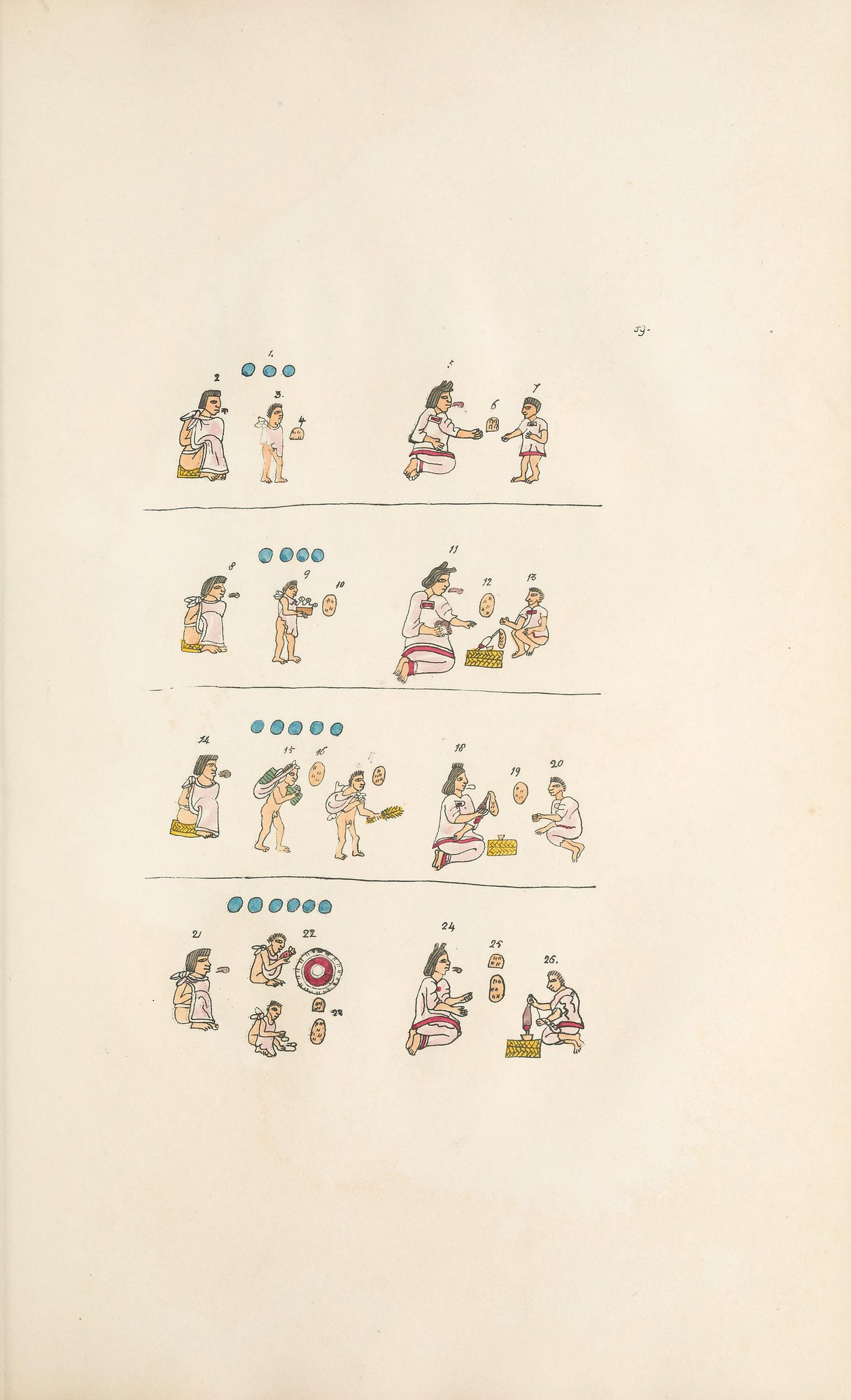
Ages three to six (folio 58r)
This explains the next page and its pictures. It shows when and how the native people advised their children on how to live. The pictures run in order in four sections, as follows.
First section. Here the parents correct their children by giving them good advice, when the children are three years old. At each meal they gave them half a tortilla.1
1. Three years old.2 2. The boy's father. 3. The boy. 4. Half a tortilla. 5. The girl's mother. 6. Half a tortilla. 7. A girl three years old.
Second section. The parents go on teaching their children, now four years old. They begin to train them by sending them on small, easy errands. At each meal they gave them one tortilla.
8. The boy's father. 9. A boy four years old. 10. One tortilla. 11. The girl's mother. 12. One tortilla. 13. A girl four years old.
Third section. At five, the parents kept their children busy with work for their bodies. They gave them light loads of firewood to carry, and small bundles to take to the tianguis, the market.3 They began to teach girls of this age how to hold the spindle and distaff to spin.4 Ration: one tortilla.
14. The boys' father. 15. Two boys five years old. 16. One tortilla. 17. One tortilla. 18. The girl's mother. 19. One tortilla. 20. A girl five years old.
Fourth section. At six, the parents trained their children in work that would be of some use to them. The boys went to the tianguis, the markets, to pick up the grains of maize spilled on the ground, and beans and other scraps that traders had dropped. The girls were set to spinning and other useful tasks. That way, from then on, these tasks would fill their time and they would not be idle. This kept them from the bad habits that idleness usually brings. At each meal the boys got a tortilla and a half.
21. The father of the two boys. 22. Two boys six years old. 23. A tortilla and a half. 24. The girl's mother. 25. A tortilla and a half. 26. A girl six years old.
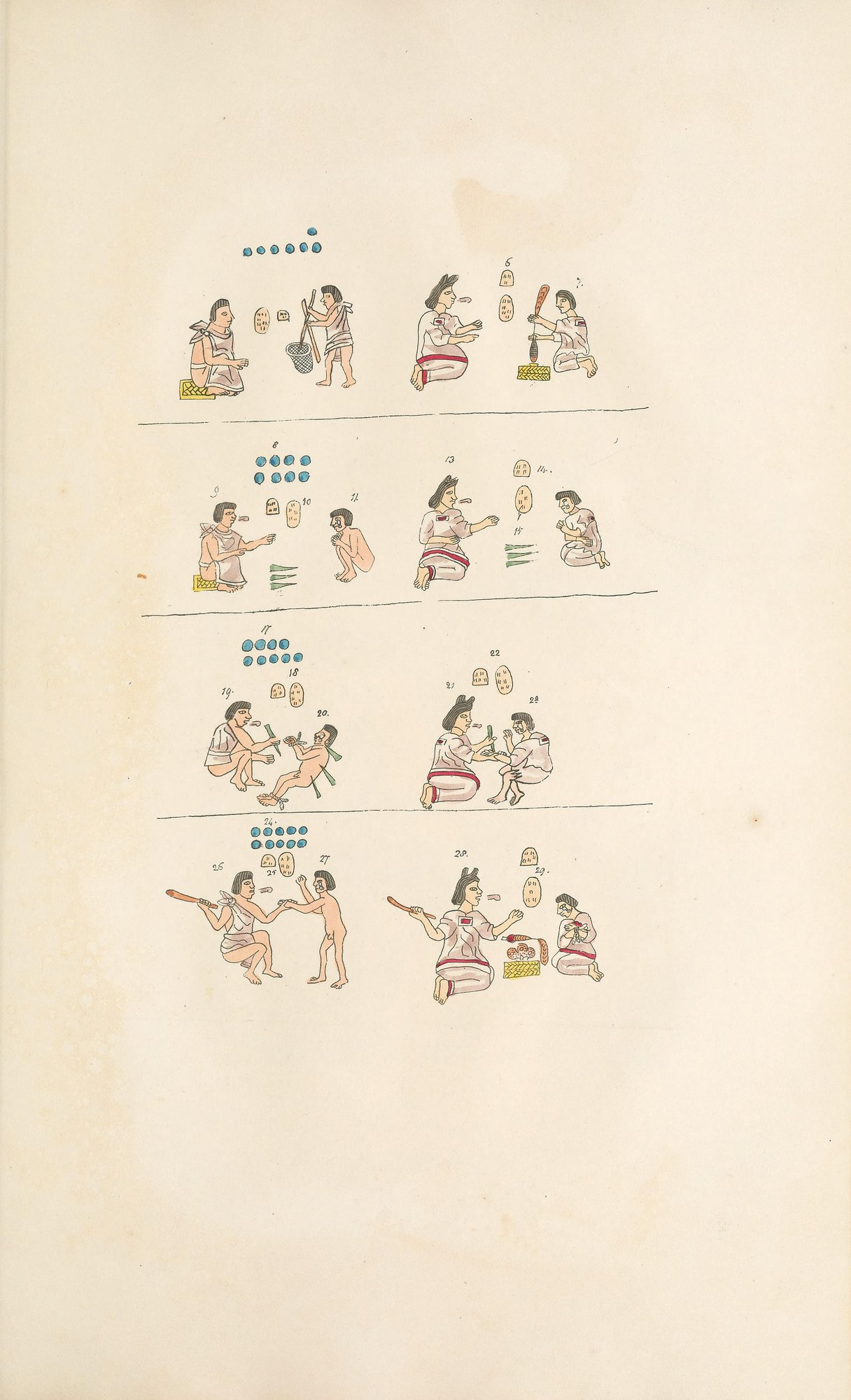
Ages seven to ten (folio 59r)
This explains the next page and its pictures. It shows when and how the native people of Mexico taught and corrected their children, to keep them from all idleness, so that they would always work hard and keep busy with useful things. The pictures run in order in four sections, explained here one by one.
First section. At seven, fathers put their sons to work, giving them the nets they fished with. Mothers trained their daughters in spinning and gave them good advice, so that they would always work hard, keep busy and never be idle. At each meal the children got a tortilla and a half.
1. These seven blue dots mean seven years. 2. The father of the boys in this row.5 3. A tortilla and a half. 4. A boy of seven, whose father is teaching him to fish with the net he holds. 5. The mother of the girls in this row. 6. A tortilla and a half. 7. A girl of seven, whose mother is teaching her to spin.
Second section. At eight, the parents punished their children by frightening them with maguey spines:6 if they were careless or disobeyed their parents, they would be punished with the spines. So the boys cried from fear, as the pictures in this section show. Their fixed ration of food was a tortilla and a half.
8. These eight dots mean eight years. 9. The father of the boys in this row. 10. A tortilla and a half. 11. A boy of eight. His father warns him not to be a good-for-nothing, or he will punish him in public by pricking his body with spines. 12. Maguey spines. 13. The mother of the girls in this row. 14. A girl of eight. Her mother threatens her with maguey spines and warns her not to be a good-for-nothing. 15. Maguey spines.
Third section. At nine, if children would not be corrected and rebelled against their parents, the parents punished them with the maguey spines. They tied a boy hand and foot, stripped naked, and stuck the spines into his back and body. They pricked the girls' hands with the spines, as the third section shows. Their ration was a tortilla and a half.
17. These nine dots mean nine years. 18. A tortilla and a half. 19. The father of the boys in this row. 20. A boy of nine. Because he will not be corrected, his father sticks maguey spines into his body. 21. The mother of the girls in this row. 22. A tortilla and a half. 23. A girl of nine. Her mother punishes her for carelessness by pricking her hands with spines.
Fourth section. At ten, if children rebelled, the parents punished them too, beating them with sticks and threatening them in other ways, as the fourth section shows. Their fixed ration was a tortilla and a half.
24. These ten dots mean ten years. 25. A tortilla and a half. 26. The father of the boys in this row. 27. A boy of ten, whom his father is beating with a stick. 28. The mother of the girl in this row. 29. A tortilla and a half. 30. A girl of ten, whom her mother is beating with a stick.
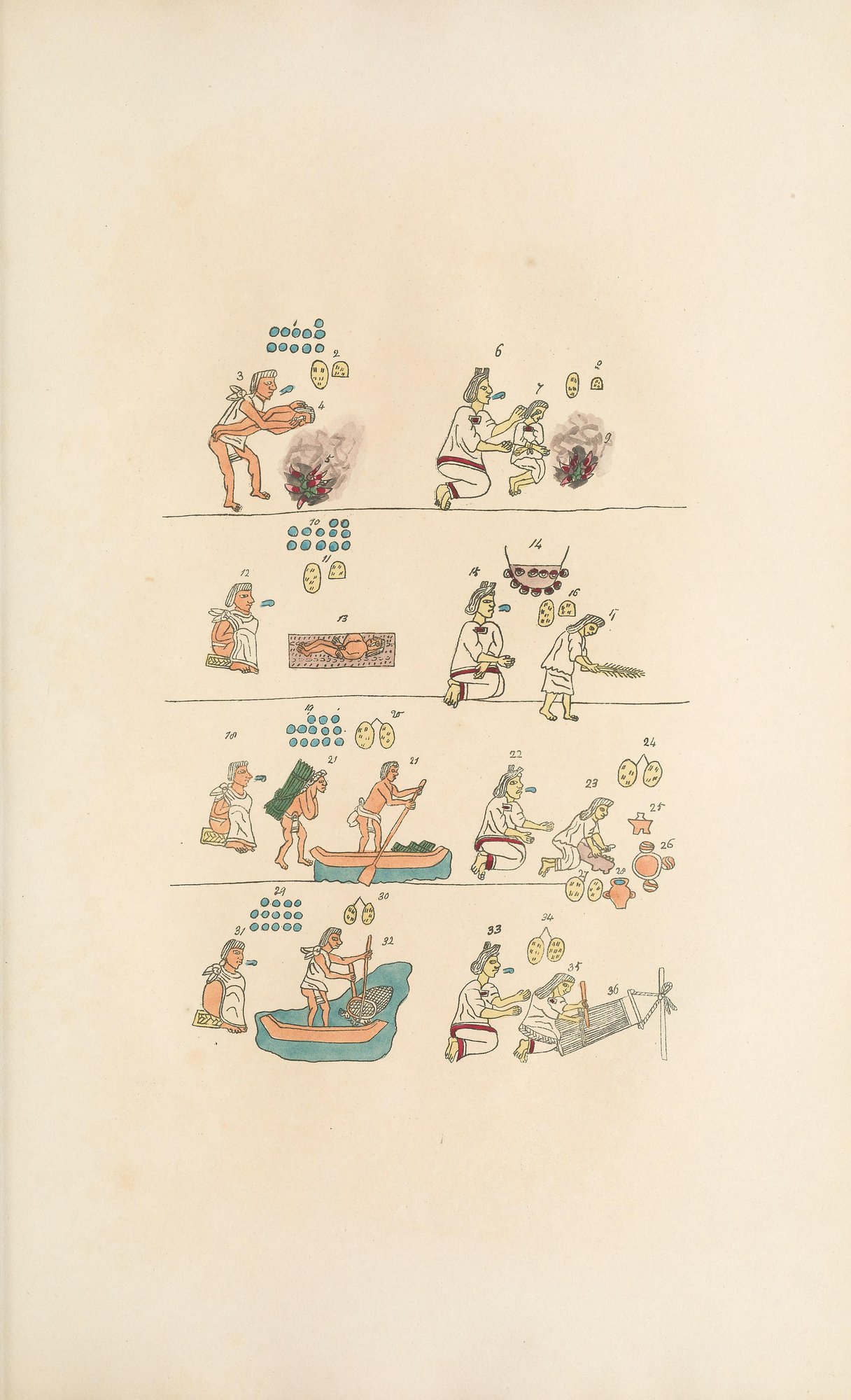
Ages eleven to fourteen (folio 60r)
This explains the first section of the next page. If a boy or girl of eleven would not take correction from words, the parents punished them by making them breathe chili smoke through the nose.7 It was a harsh and cruel torment. It was meant to make them mend their ways, so that they would not grow up wicked and idle wanderers but would spend their time on useful things. Boys of this age got their bread, which is tortillas, by a fixed measure: only a tortilla and a half at each meal, so that they would not learn to be greedy eaters.
1. These eleven blue dots mean eleven years. 2. A tortilla and a half. 3. The father of the boys in this row. 4. A boy of eleven. His father is punishing him by making him breathe the smoke of dried chilies through his nose. 5. The chili smoke. 6. The mother of the girls in this row. 7. A girl of eleven. Her mother is punishing her and is about to hold her in the chili smoke. 8. A tortilla and a half. 9. Chili smoke.
Section two. If a boy or girl of twelve would not take correction or advice from the parents, the father took the boy, tied him hand and foot, stripped him naked and laid him on the ground in a damp, wet place. He left him there a whole day, so that the punishment would make him mend his ways and fear. The mother made a girl of this age work at night, before daybreak, sweeping the house and the street, and kept her always busy with work. Here too the parents gave them a fixed amount to eat.
10. Twelve years. 11. A tortilla and a half. 12. The father of the boys in this row. 13. A boy of twelve, lying on wet ground, tied hand and foot for a whole day. 14. This picture means the night. 15. The mother of the girls in this row. 16. A tortilla and a half. 17. A girl of twelve, sweeping at night.
This explains the third section of the next page. At thirteen, the parents set the boys to bringing firewood from the woods, and reeds and other plants for the household by canoe. The girls had to grind maize and make tortillas and other dishes for their parents. The boys' fixed ration was two tortillas each at each meal.
18. The father of the boys in this row. 19. Thirteen years. 20. Two tortillas. 21. A boy of thirteen carrying a load of firewood. 21. A canoe with its bundles of reeds. 22. The mother of the girls in this row. 23. A girl of thirteen making tortillas and cooking. 24. Two tortillas. 25. A bowl. 26. A griddle (comal).8 27, 28. A pot of stew and two tortillas.
This explains the fourth section of the next page. At fourteen, the parents kept their children busy. The boy went out in a canoe to fish on the lakes, and the girls were set to weaving all kinds of cloth for clothing. Their fixed ration was two tortillas.
29. Fourteen years. 30. Two tortillas. 31. The father of the boys in this row. 32. A boy of fourteen, fishing from his canoe. 33. The mother of the girls in this row. 34. Two tortillas. 35. A girl of fourteen, weaving. 36. The cloth and the loom.
Notes
- A tortilla is a thin round flatbread of maize dough, baked on a clay griddle. It was the everyday bread of central Mexico; the interpreter later calls tortillas “bread.” back
- In the paintings each blue dot stands for one year of the child's age, and each small round or oval sign beside a figure is a tortilla, whole or half. A small scroll before a parent's mouth shows that the parent is speaking. back
- Tianguis, from Nahuatl tianquiztli, “market,” was the word Spaniards in Mexico took up for a native market. back
- Huso and rueca, spindle and distaff, the tools for spinning thread by hand. In the picture the five-year-old girl only watches; at six she holds the spindle herself. back
- Hazera (hacera): a row of pictures across the page. In each row the father and son are on the left, the mother and daughter on the right. back
- The maguey is the agave plant, whose thick leaves end in long, hard spines. Kingsborough's English edition notes that the Mexica also used the spines to draw their own blood in penance. back
- Axi (ají) is the Caribbean word for chili pepper that Spaniards used everywhere in the Americas. In the picture the chilies burn in a heap, and the parent holds the child over the smoke. back
- A comal (Nahuatl comalli) is a flat clay griddle set over the fire, on which tortillas are baked. back
Declaracion de la plana siguiente despues desta, de las figuras en ella contenidas, en que se platica el tiempo y modo en que los naturales davan consejo á sus hijos de como havian de vivir, segun que sucesivamente estan figurados, que son cuatro partidas que son las que siguen.
Declaration of the following page after this one, of the figures contained in it, in which is told the time and manner in which the natives gave advice to their children on how they were to live, as they are depicted in succession, which are four sections, which are those that follow.
This explains the next page and its pictures. It shows when and how the native people advised their children on how to live. The pictures run in order in four sections, as follows.
Primera partida, en que se figura que los padres correjian en dar buen consejo á sus hijos, cuando heran de edad de tres años, y la racion que les davan en cada una comida era media tortilla.
First section, in which is shown that the parents corrected [their children] by giving good advice to their children, when they were of the age of three years, and the ration that they gave them at each meal was half a tortilla.
First section. Here the parents correct their children by giving them good advice, when the children are three years old. At each meal they gave them half a tortilla.
- A tortilla is a thin round flatbread of maize dough, baked on a clay griddle. It was the everyday bread of central Mexico; the interpreter later calls tortillas “bread.”
1. Tres años de edad. 2. Padre del muchacho. 3. Muchacho. 4. Media tortilla. 5. Madre de la muchacha. 6. Media tortilla. 7. Muchacha de edad de tres años.
1. Three years of age. 2. Father of the boy. 3. Boy. 4. Half tortilla. 5. Mother of the girl. 6. Half tortilla. 7. Girl of the age of three years.
1. Three years old. 2. The boy's father. 3. The boy. 4. Half a tortilla. 5. The girl's mother. 6. Half a tortilla. 7. A girl three years old.
- In the paintings each blue dot stands for one year of the child's age, and each small round or oval sign beside a figure is a tortilla, whole or half. A small scroll before a parent's mouth shows that the parent is speaking.
Segunda partida en que estan figurados los padres que ansi mismo dotrinavan á sus hijos, cuando heran de edad de cuatro años, y los empezaban á ejercitar en mandalles servir en cosas pocas é livianas; la racion que en cada una comida les davan era una tortilla.
Second section in which are depicted the parents who likewise instructed their children, when they were of the age of four years, and began to train them in ordering them to serve in few and light things; the ration that at each meal they gave them was one tortilla.
Second section. The parents go on teaching their children, now four years old. They begin to train them by sending them on small, easy errands. At each meal they gave them one tortilla.
8. Padre del muchacho. 9. Muchacho de edad de cuatro años. 10. Una tortilla. 11. Madre de la muchacha. 12. Una tortilla. 13. Muchacha de cuatro años de edad.
8. Father of the boy. 9. Boy of the age of four years. 10. One tortilla. 11. Mother of the girl. 12. One tortilla. 13. Girl of four years of age.
8. The boy's father. 9. A boy four years old. 10. One tortilla. 11. The girl's mother. 12. One tortilla. 13. A girl four years old.
Tercera partida, en la cual estan figurados los padres que á sus hijos de edad de cinco años los ocupavan y ejercitavan á fuerzas personales, como cargallas de leña cargas de poco peso, llevar envoltorios de poco peso al tiangues, lugar de mercados, y á las muchachas desta edad, las ponian en enseñallas como havian de tomar el uso y rueca para hilar. Racion una tortilla.
Third section, in which are depicted the parents who kept their children of the age of five years busy and trained them in bodily labors, such as loading them with firewood, loads of little weight, carrying bundles of little weight to the tianguis, place of markets; and the girls of this age, they set about teaching them how they were to take the spindle and distaff to spin. Ration one tortilla.
Third section. At five, the parents kept their children busy with work for their bodies. They gave them light loads of firewood to carry, and small bundles to take to the tianguis, the market. They began to teach girls of this age how to hold the spindle and distaff to spin. Ration: one tortilla.
- Tianguis, from Nahuatl tianquiztli, “market,” was the word Spaniards in Mexico took up for a native market.
- Huso and rueca, spindle and distaff, the tools for spinning thread by hand. In the picture the five-year-old girl only watches; at six she holds the spindle herself.
14. Padre de los muchachos. 15. Dos muchachos de edad de cinco años. 16. Una tortilla. 17. Una tortilla. 18. Madre de la muchacha. 19. Una tortilla. 20. Muchacha de cinco años.
14. Father of the boys. 15. Two boys of the age of five years. 16. One tortilla. 17. One tortilla. 18. Mother of the girl. 19. One tortilla. 20. Girl of five years.
14. The boys' father. 15. Two boys five years old. 16. One tortilla. 17. One tortilla. 18. The girl's mother. 19. One tortilla. 20. A girl five years old.
Quarta partida en la cual estan figurados los padres que á sus hijos de edad de seis años los ejercitavan y ocupavan en servicios personales, de que en algo aprovechasen á sus padres, ansi como en los tianquez, lugares de mercado, para que cojiesen del suelo los granos de maiz que por él estuviesen derramados, y frisoles y otras miserias, y cosas que los tratantes dejavan derramadas, esto es á los muchachos, y á las muchachas las imponian en el ylar, y otras cosas de servicios de provecho, para que en lo de adelante, mediante los dichos servicios y ocupaciones, ocupasen el tiempo en no estar ociosos, por les evitar vicios malos, que la ociosidad suele acarrear. Racion que á los muchachos davan en cada una comida era una tortilla y media.
Fourth section in which are depicted the parents who trained and occupied their children of the age of six years in personal services, by which they might profit their parents in something, such as in the tianguis, places of market, so that they would pick up from the ground the grains of maize that were spilled on it, and beans and other trifles, and things that the traders left spilled; this is for the boys; and the girls they set to spinning, and other useful tasks of service, so that in the time ahead, by means of the said services and occupations, they would spend the time in not being idle, to keep them from bad vices, which idleness is wont to bring. Ration that they gave the boys at each meal was one tortilla and a half.
Fourth section. At six, the parents trained their children in work that would be of some use to them. The boys went to the tianguis, the markets, to pick up the grains of maize spilled on the ground, and beans and other scraps that traders had dropped. The girls were set to spinning and other useful tasks. That way, from then on, these tasks would fill their time and they would not be idle. This kept them from the bad habits that idleness usually brings. At each meal the boys got a tortilla and a half.
21. Padre de los dos muchachos. 22. Dos muchachos de seis años. 23. Tortilla y media. 24. Madre de la muchacha. 25. Una tortilla y media. 26. Muchacha de seis años.
21. Father of the two boys. 22. Two boys of six years. 23. Tortilla and a half. 24. Mother of the girl. 25. One tortilla and a half. 26. Girl of six years.
21. The father of the two boys. 22. Two boys six years old. 23. A tortilla and a half. 24. The girl's mother. 25. A tortilla and a half. 26. A girl six years old.
Declaracion de la plana siguiente de las figuras en ella contenidas, en que se platica el tiempo y modo en que los naturales de Mexico dotrinavan y corregian á sus hijos, para evitalles toda ociosidad, y que siempre anduviesen aplicados, y se ejercitasen en cosas de provecho, segun que sucesivamente estan figurados, que son cuatro partidas, y ansi en esta plana por su orden van declaradas las cuatro partidas, que son las que se siguen.
Declaration of the following page, of the figures contained in it, in which is told the time and manner in which the natives of Mexico instructed and corrected their children, to keep them from all idleness, and that they should always go about diligent, and exercise themselves in useful things, as they are depicted in succession, which are four sections, and so on this page in their order the four sections are declared, which are those that follow.
This explains the next page and its pictures. It shows when and how the native people of Mexico taught and corrected their children, to keep them from all idleness, so that they would always work hard and keep busy with useful things. The pictures run in order in four sections, explained here one by one.
Primera partida. En que se declara que los padres á sus hijos de edad de siete años, á los varones, les aplicavan en dalles sus redes con que pescavan. Y las madres ejercitaban á sus hijas en hilar, y en darlas buenos consejos, para que siempre se aplicasen, y ocupasen el tiempo en algo, para escusar toda ociosidad. La racion que les davan á sus hijos en cada una comida era una tortilla y media.
First section. In which is declared that the fathers set their children of the age of seven years, the males, [to work] in giving them their nets with which they fished. And the mothers trained their daughters in spinning, and in giving them good advice, so that they would always apply themselves, and spend the time in something, to avoid all idleness. The ration that they gave their children at each meal was one tortilla and a half.
First section. At seven, fathers put their sons to work, giving them the nets they fished with. Mothers trained their daughters in spinning and gave them good advice, so that they would always work hard, keep busy and never be idle. At each meal the children got a tortilla and a half.
1. Estas siete pintas de azul significan siete años. 2. Padre de los muchachos en esta hazera contenidos. 3. Una tortilla y media. 4. Muchacho de siete años que su padre le está enseñado como ha de pescar con la red que tiene en sus manos. 5. Madre de las muchachas en esta hazera contenidas. 6. Una tortilla y media. 7. Muchacha de siete años; su madre le está enseñando á ylar.
1. These seven blue dots signify seven years. 2. Father of the boys contained in this row. 3. One tortilla and a half. 4. Boy of seven years whom his father is teaching how he is to fish with the net that he has in his hands. 5. Mother of the girls contained in this row. 6. One tortilla and a half. 7. Girl of seven years; her mother is teaching her to spin.
1. These seven blue dots mean seven years. 2. The father of the boys in this row. 3. A tortilla and a half. 4. A boy of seven, whose father is teaching him to fish with the net he holds. 5. The mother of the girls in this row. 6. A tortilla and a half. 7. A girl of seven, whose mother is teaching her to spin.
- Hazera (hacera): a row of pictures across the page. In each row the father and son are on the left, the mother and daughter on the right.
Segunda partida en que se declara que los padres á sus hijos de edad de ocho años los castigavan, poniendoles por delante temores y aterrores de puas de maguey, para que siendo neglijentes y desobedientes á sus padres, serian castigados con las dichas puas, y ansi los muchachos de temor lloravan, segun que en las figuras desta partida estan figuradas é significadas. La racion de comida que les davan por tasa hera una tortilla y media.
Second section in which is declared that the parents punished their children of the age of eight years, putting before them fears and terrors of maguey spines, so that, being negligent and disobedient to their parents, they would be punished with the said spines, and so the boys wept from fear, as in the figures of this section they are depicted and signified. The ration of food that they gave them by measure was one tortilla and a half.
Second section. At eight, the parents punished their children by frightening them with maguey spines: if they were careless or disobeyed their parents, they would be punished with the spines. So the boys cried from fear, as the pictures in this section show. Their fixed ration of food was a tortilla and a half.
- The maguey is the agave plant, whose thick leaves end in long, hard spines. Kingsborough's English edition notes that the Mexica also used the spines to draw their own blood in penance.
8. Estas ocho pintas significan ocho años. 9. Padre de los muchachos en esta hazera contenidos. 10. Una tortilla y media. 11. Muchacho de ocho años que su padre le amenaza no sea vellaco, por que le castigará en público el cuerpo con puas. 12. Puas de maguey. 13. Madre de las muchachas que estan en esta hazera contenidas. 14. Muchacha de ocho años, que su madre le amenaza con puas de maguey que no sea vellaca. 15. Puas de maguey.
8. These eight dots signify eight years. 9. Father of the boys contained in this row. 10. One tortilla and a half. 11. Boy of eight years whom his father threatens [that he] not be a rascal, because he will punish his body in public with spines. 12. Maguey spines. 13. Mother of the girls who are contained in this row. 14. Girl of eight years, whom her mother threatens with maguey spines [that she] not be a rascal. 15. Maguey spines.
8. These eight dots mean eight years. 9. The father of the boys in this row. 10. A tortilla and a half. 11. A boy of eight. His father warns him not to be a good-for-nothing, or he will punish him in public by pricking his body with spines. 12. Maguey spines. 13. The mother of the girls in this row. 14. A girl of eight. Her mother threatens her with maguey spines and warns her not to be a good-for-nothing. 15. Maguey spines.
Tercera partida en que se declara que los padres á sus hijos de edad de nueve años, siendo incorrejibles y rebeldes á sus padres, castigavan á sus hijos con las dichas puas de maguey, atando al muchacho de pies y manos, desnudo en carnes, y le incavan las dichas puas por las espaldas, y cuerpo, y á las muchachas, les punzavan las manos con las puas, segun que en la tercera partida estan figuradas. La racion de comida que les davan hera una tortilla y media.
Third section in which is declared that the parents, their children of the age of nine years being incorrigible and rebellious to their parents, punished their children with the said maguey spines, tying the boy by feet and hands, naked in the flesh, and they stuck the said spines into his back and body; and the girls, they pricked their hands with the spines, as in the third section they are depicted. The ration of food that they gave them was one tortilla and a half.
Third section. At nine, if children would not be corrected and rebelled against their parents, the parents punished them with the maguey spines. They tied a boy hand and foot, stripped naked, and stuck the spines into his back and body. They pricked the girls' hands with the spines, as the third section shows. Their ration was a tortilla and a half.
17. Estas nueve pintas significan nueve años. 18. Una tortilla y media. 19. Padre de los muchachos en esta hazera contenidos. 20. Muchacho de nueve años por incorrejible, su padre le hinca puas de maguey por el cuerpo. 21. Madre de las muchachas en esta hazera contenidas. 22. Una tortilla y media. 23. Muchacha de nueve años, que por su neglijencia la castiga su madre, punzandola las manos con puas.
17. These nine dots signify nine years. 18. One tortilla and a half. 19. Father of the boys contained in this row. 20. Boy of nine years, for [being] incorrigible, his father sticks maguey spines into his body. 21. Mother of the girls contained in this row. 22. One tortilla and a half. 23. Girl of nine years, whom for her negligence her mother punishes, pricking her hands with spines.
17. These nine dots mean nine years. 18. A tortilla and a half. 19. The father of the boys in this row. 20. A boy of nine. Because he will not be corrected, his father sticks maguey spines into his body. 21. The mother of the girls in this row. 22. A tortilla and a half. 23. A girl of nine. Her mother punishes her for carelessness by pricking her hands with spines.
Cuarta partida, en que se declara que los padres á sus hijos de edad de diez años ansi mismo los castigavan, siendoles rebeldes, dandoles de palos, y haciendoles otras amenazas, segun que en la cuarta partida estan figurados. La tasa y racion que les davan hera una tortilla y media.
Fourth section, in which is declared that the parents likewise punished their children of the age of ten years, they being rebellious to them, giving them blows with sticks, and making them other threats, as in the fourth section they are depicted. The measure and ration that they gave them was one tortilla and a half.
Fourth section. At ten, if children rebelled, the parents punished them too, beating them with sticks and threatening them in other ways, as the fourth section shows. Their fixed ration was a tortilla and a half.
24. Estas diez pintas significan diez años. 25. Una tortilla y media. 26. El padre de los muchachos en esta hazera contenidos. 27. Muchacho de diez años que su padre le está castigando con un palo. 28. Madre de la muchacha en esta hazera contenida. 29. Una tortilla y media. 30. Muchacha de diez años que su madre la está castigando con un palo.
24. These ten dots signify ten years. 25. One tortilla and a half. 26. The father of the boys contained in this row. 27. Boy of ten years whom his father is punishing with a stick. 28. Mother of the girl contained in this row. 29. One tortilla and a half. 30. Girl of ten years whom her mother is punishing with a stick.
24. These ten dots mean ten years. 25. A tortilla and a half. 26. The father of the boys in this row. 27. A boy of ten, whom his father is beating with a stick. 28. The mother of the girl in this row. 29. A tortilla and a half. 30. A girl of ten, whom her mother is beating with a stick.
Declaracion de la partida primera de la plana siguiente de lo figurado. El muchacho ó muchacha de onze años, que no recibia correccion de palabra, sus padres los castigavan dandoles humo en las narizes con axi, que hera un tormento grave y cruel, para que se castigasen, y no handuviesen viciados é vagamundos, si no que se aplicasen en ocupar el tiempo en cosas provechosas. A los muchachos de tal edad dabanles el pan, que son tortillas, por tasa solamente una tortilla y media, á cada comida, por que no se enseñasen à ser tragones ó glotones.
Declaration of the first section of the following page, of what is depicted. The boy or girl of eleven years who did not receive correction by word, their parents punished them giving them smoke in the nostrils with chili, which was a grave and cruel torment, so that they would mend, and not go about corrupted and vagabonds, but that they would apply themselves to spending the time in profitable things. To the boys of such age they gave them the bread, which is tortillas, by measure only one tortilla and a half, at each meal, so that they would not learn to be gluttons or greedy.
This explains the first section of the next page. If a boy or girl of eleven would not take correction from words, the parents punished them by making them breathe chili smoke through the nose. It was a harsh and cruel torment. It was meant to make them mend their ways, so that they would not grow up wicked and idle wanderers but would spend their time on useful things. Boys of this age got their bread, which is tortillas, by a fixed measure: only a tortilla and a half at each meal, so that they would not learn to be greedy eaters.
- Axi (ají) is the Caribbean word for chili pepper that Spaniards used everywhere in the Americas. In the picture the chilies burn in a heap, and the parent holds the child over the smoke.
1. Estas onze pintas de azul significan onze años. 2. Una tortilla y media. 3. Padre de los muchachos de esta hazera. 4. Muchacho de once años que su padre le está castigando, dandole humo por las narizes, con axi seco. 5. Saumerio ó humazo de axi. 6. Madre de las muchachas de esta hazera. 7. Muchacha de once años que su madre la está castigando, queriendola dar humo con axi. 8. Una tortilla y media. 9. Saumerio de axi.
1. These eleven blue dots signify eleven years. 2. One tortilla and a half. 3. Father of the boys of this row. 4. Boy of eleven years whom his father is punishing, giving him smoke through the nostrils, with dry chili. 5. Fumigation or smoke of chili. 6. Mother of the girls of this row. 7. Girl of eleven years whom her mother is punishing, wanting to give her smoke with chili. 8. One tortilla and a half. 9. Fumigation of chili.
1. These eleven blue dots mean eleven years. 2. A tortilla and a half. 3. The father of the boys in this row. 4. A boy of eleven. His father is punishing him by making him breathe the smoke of dried chilies through his nose. 5. The chili smoke. 6. The mother of the girls in this row. 7. A girl of eleven. Her mother is punishing her and is about to hold her in the chili smoke. 8. A tortilla and a half. 9. Chili smoke.
Declaracion de lo figurado en la partida segunda. El muchacho ó muchaca de edad de doce años que no recibia de sus padres correccion ni consejo, al muchacho tomava su padre, y le ataba de pies y manos, y desnudo en carnes, lo tendia en el suelo en parte humeda é mojada, donde todo un dia lo tenia ansi, para que con tal pena castigase y temiese, y á la muchacha de la dicha edad, su madre la hacia servir de noche, antes que fuese de dia, la ocupava en barrer la casa y la calle, y que siempre se ocupase en servicios personales. Ansi mismo sus padres les davan de comer por tasa.
Declaration of what is depicted in the second section. The boy or girl of the age of twelve years who did not receive correction or advice from their parents: the boy, his father took him, and tied him by feet and hands, and naked in the flesh, laid him on the ground in a damp and wet place, where he kept him so a whole day, so that with such a penalty he would mend and fear; and the girl of the said age, her mother made her serve at night, before it was day; she kept her busy sweeping the house and the street, and [made sure] that she was always busy in personal services. Likewise their parents gave them to eat by measure.
Section two. If a boy or girl of twelve would not take correction or advice from the parents, the father took the boy, tied him hand and foot, stripped him naked and laid him on the ground in a damp, wet place. He left him there a whole day, so that the punishment would make him mend his ways and fear. The mother made a girl of this age work at night, before daybreak, sweeping the house and the street, and kept her always busy with work. Here too the parents gave them a fixed amount to eat.
10. Doce años. 11. Una tortilla y media. 12. Padre de los muchachos desta hazera. 13. Muchacho de doce años tendido sobre tierra mojada, atado de pies y manos por todo un dia. 14. Esta pintura significa la noche. 15. Madre de las muchachas desta hacera. 16. Una torta y media. 17. Muchacha de doce años que de noche anda barriendo.
10. Twelve years. 11. One tortilla and a half. 12. Father of the boys of this row. 13. Boy of twelve years lying on wet earth, tied by feet and hands for a whole day. 14. This painting signifies the night. 15. Mother of the girls of this row. 16. One tortilla [torta] and a half. 17. Girl of twelve years who at night goes sweeping.
10. Twelve years. 11. A tortilla and a half. 12. The father of the boys in this row. 13. A boy of twelve, lying on wet ground, tied hand and foot for a whole day. 14. This picture means the night. 15. The mother of the girls in this row. 16. A tortilla and a half. 17. A girl of twelve, sweeping at night.
Declaracion de lo figurado en la partida tercera de la plana siguiente. El muchacho ó muchacha de edad de treze años, sus padres los aplicavan en traer leña del monte, y con canoa traer carrizos, y otras yerbas para servicio de casa, y á las muchachas, que moleliesen iciesen tortillas y otros guisados para sus padres; davanles de comer por tasa á los muchachos dos tortillas á cada uno en cada una comida.
Declaration of what is depicted in the third section of the following page. The boy or girl of the age of thirteen years, their parents set them to bringing firewood from the woods, and with a canoe bringing reeds, and other plants for the service of the house; and the girls, that they grind [and] make tortillas and other cooked dishes for their parents; they gave them to eat by measure, the boys two tortillas each at each meal.
This explains the third section of the next page. At thirteen, the parents set the boys to bringing firewood from the woods, and reeds and other plants for the household by canoe. The girls had to grind maize and make tortillas and other dishes for their parents. The boys' fixed ration was two tortillas each at each meal.
18. Padre de los muchachos desta hacera. 19. Trece años. 20. Dos tortillas. 21. Muchacho de trece años que va cargado con leña. 21. Canoa con sus haces de cañas. 22. Madre de las muchachas desta hacera. 23. Muchacha de trece años que hace tortillas, y guisa de comer. 24. Dos tortillas. 25. Escudilla. 26. Comali. 27, 28. Olla guisada y dos tortillas.
18. Father of the boys of this row. 19. Thirteen years. 20. Two tortillas. 21. Boy of thirteen years who goes loaded with firewood. 21. Canoe with its bundles of canes. 22. Mother of the girls of this row. 23. Girl of thirteen years who makes tortillas, and cooks food. 24. Two tortillas. 25. Bowl. 26. Comal. 27, 28. Pot of cooked food and two tortillas.
18. The father of the boys in this row. 19. Thirteen years. 20. Two tortillas. 21. A boy of thirteen carrying a load of firewood. 21. A canoe with its bundles of reeds. 22. The mother of the girls in this row. 23. A girl of thirteen making tortillas and cooking. 24. Two tortillas. 25. A bowl. 26. A griddle (comal). 27, 28. A pot of stew and two tortillas.
- A comal (Nahuatl comalli) is a flat clay griddle set over the fire, on which tortillas are baked.
Declaracion de lo figurado en la cuarta partida de la plana siguiente. El muchacho ó muchacha de edad de catorce años, sus padres los ocupavan y aplicavan, de que el muchacho fuese con canoa á pescar en las lagunas y á las muchachas las imponian á que texiesen cualquiera tela de ropa. Dabanles á comer por tasa dos tortillas.
Declaration of what is depicted in the fourth section of the following page. The boy or girl of the age of fourteen years, their parents occupied and set them, that the boy should go with a canoe to fish in the lakes, and the girls they set to weaving any cloth of clothing. They gave them to eat by measure two tortillas.
This explains the fourth section of the next page. At fourteen, the parents kept their children busy. The boy went out in a canoe to fish on the lakes, and the girls were set to weaving all kinds of cloth for clothing. Their fixed ration was two tortillas.
29. Catorce años. 30. Dos tortillas. 31. Padre de los muchachos desta hacera. 32. Muchacho de catorce años que anda á pescar con su canoa. 33. Madre de las muchachas desta hacera. 34. Dos tortillas. 35. Muchacha de catorce años que está tejiendo. 36. Tela y telar.
29. Fourteen years. 30. Two tortillas. 31. Father of the boys of this row. 32. Boy of fourteen years who goes fishing with his canoe. 33. Mother of the girls of this row. 34. Two tortillas. 35. Girl of fourteen years who is weaving. 36. Cloth and loom.
29. Fourteen years. 30. Two tortillas. 31. The father of the boys in this row. 32. A boy of fourteen, fishing from his canoe. 33. The mother of the girls in this row. 34. Two tortillas. 35. A girl of fourteen, weaving. 36. The cloth and the loom.
Who and what this source names, in the original. Each name links to every source in the library that mentions it. Not yet checked.
Ideas
- Chili The hot peppers of the Americas, called chilli in Nahuatl and ají in the Caribbean. Europeans took them home in the 1500s, and Francisco Hernández described many Mexican kinds. Sections 61.1, 61.1k.
- Maguey (agave) The agave plant of Mexico, whose fibers made cloth and rope, whose leaves served as fuel and food, and whose sap was fermented into pulque. Sections 60.2, 60.2k, 60.3, 60.3k.
- Maize (corn) The grain of the Americas, eaten as bread, porridge and drink and planted in hills or holes made with a stick. English writers called it Indian corn. Sections 59.4.
- Markets and trade Buying, selling and trading goods: markets, merchants, money and the routes along which goods traveled. Sections 59.3, 59.4.
- Raising children How parents fed, taught, set to work and punished their children, and what they hoped the children would become. Sections 59.0, 60.0.
- Spinning and weaving Making thread with a spindle and cloth on a loom. In Mexica households it was women's work, taught to girls from about the age of five. Sections 59.3, 59.4, 60.1, 60.1k, 61.4, 61.4k.
- Tortillas Thin round flatbreads of maize dough baked on a clay griddle, the everyday bread of central Mexico. The Codex Mendoza measures children's meals in them. Sections 59.1, 59.1k, 59.2, 59.2k, 59.3, 59.3k, 59.4, 59.4k, 60.1, 60.1k, 60.2, 60.2k, 60.3, 60.3k, 60.4, 60.4k, 61.1, 61.1k, 61.2k, 61.3, 61.3k, 61.4, 61.4k.
- Women's work The work that writers assign to women: keeping the house and its stores, making cloth and food, running the dairy, or planting and harvesting the fields. Sections 61.2, 61.3.
Peoples
Places
- Mexico-Tenochtitlan The Mexica capital, built on an island in a lake in the Valley of Mexico. Cortés entered it in November 1519, was driven out in June 1520, and took it by siege in 1521; Mexico City was built on its site. Sections 60.0.
Page images of the original object or of the printed edition, from the libraries and archives that hold them. The pages shown are copied here where the holder marks them public domain; titles link to the holder's own viewer. Click a page to see it full size.
Codex Mendoza, Bodleian Library MS. Arch. Selden. A. 1
Bodleian Libraries, University of Oxford (Digital Bodleian). fols. 57v–60r. Photo: © Bodleian Libraries, University of Oxford. Terms of use: CC BY-NC 4.0.
The manuscript itself, in full color, with the Spanish explanations on the left-hand pages and short Spanish glosses on the paintings.
Kingsborough, Antiquities of Mexico, vol. 1 (London, 1831): the Codex Mendoza plates
Smithsonian Libraries, via the Internet Archive. plates LIX–LXI. Public domain (published 1831).
The lithographs shown here.
Smithsonian Libraries, via the Internet Archive. pp. 92–97. Public domain (published 1831).
The printed Spanish text our translation follows.
Other translations of this passage. Links go to copies that are free to read online.
Lord Kingsborough (anonymous translator), 1831. English. Public domain.
The whole passage (located in the OCR text; not yet read).
The Codex Mendoza, vol. 4 (Berkeley, 1992)
Frances F. Berdan and Patricia Rieff Anawalt, 1992. English. In copyright; not free online.
The whole codex (not opened).
New translation from the Spanish explanations of the Codex Mendoza as printed in Lord Kingsborough's Antiquities of Mexico, vol. 5 (London, 1831), pages 92–97. The Spanish was written by an unnamed interpreter who explained the Nahua painters' pictures; it is not a translation of a Nahuatl text. All of the explanations for these three pages are included, each followed by its numbered key.
The key's numbers match the numbers on Aglio's plates. In the manuscript itself the same words are written as short labels beside the figures. The interpreter's spelling is old Spanish (davan, hera, hazera) and is kept in the original.
The punishments are translated as the interpreter described them, without softening.
- Original
- Text as printed in the named edition or on the object, read from page images. Edition: Lord Kingsborough (Edward King), Antiquities of Mexico (London: Robert Havell and Colnaghi, 1831). Images: vol. 1, the Codex Mendoza plates LIX–LXI, hand-colored lithographs by Agostino Aglio (Smithsonian Libraries copy, Internet Archive AntiquitiesMexi1King). Spanish text: vol. 5, “Esplicacion de la Coleccion de Mendoza,” pp. 92–97 (Internet Archive AntiquitiesMexi5King), which prints the Spanish explanations written in the manuscript. Kingsborough's text only; no notes copied.
- Transliterated
- Not needed: the original is in the Latin alphabet
- Close English
- Close translation, kept as a working draft
- Simplified English
- Made by Hearth from the original. Not yet checked by a separate review.
- Editor’s review
- Not yet.
- Rights
- Original: public domain. Edition: public domain. Our translations and notes: CC BY-SA 4.0; credit “Hearth Library, hearthinteractive.com” with a link.
Sources for the notes
- Kingsborough, Edward King, Viscount. Antiquities of Mexico. 9 vols. London: Robert Havell and Colnaghi, 1831. Vol. 1, Codex Mendoza plates LIX–LXI (https://archive.org/details/AntiquitiesMexi1King); vol. 5, “Esplicacion de la Coleccion de Mendoza,” pp. 91–97 (https://archive.org/details/AntiquitiesMexi5King); vol. 6, “Interpretation of the Collection of Mendoza,” p. 56 and note (https://archive.org/details/AntiquitiesMexi6King).
- Bodleian Libraries. “MS. Arch. Selden. A. 1.” Medieval Manuscripts in Oxford Libraries (catalogue record by Matthew Holford). https://medieval.bodleian.ox.ac.uk/catalog/manuscript_8834
- Bodleian Libraries. MS. Arch. Selden. A. 1, Digital Bodleian, fols. 57v and 58r. https://digital.bodleian.ox.ac.uk/objects/2fea788e-2aa2-4f08-b6d9-648c00486220/